One bonobo's view of the world...and stuff.

Monday, October 17, 2011

Marx and Monkeys.


This is intended as the first blog in a series of (probably) three. When I get around to them.

Speak to any intelligent and informed person and they'll have to problem at all with Darwin's revelation that the rich diversity of species was brought about by competition. Neither will the 21stC reader have any problem taking this to the microbiological level. Dawkins' Selfish Gene idea of life shaped by the impersonal interactions of gene sequences and the Blind Watchmaker principle whereby order and complexity can spontaneously arise from simple, binary mutations, are common currency. As ways of making sense of the world we can simply take them as given. Perhaps slightly less well known, but still Out There (it's been on the telly with Jim al-Khalili) is Alan Turing's work on the chemical basis of morphogenisis which shows how complex patterns can emerge from chaotic conditions.

But when you mention Marx...it's all that stuff about gulags and purges...and he was hardly any good at predicting the death of Capitalism and subsequent workers' paradise, was he...and it's all old-fashioned stuff, dead and buried. And it was hardly scientific, was it?

Hmm.

Let's begin with Darwin the Philosopher. Note, incidentally, that Marx who was first and foremost a philosopher - a vital thing to remember about him - was a great admirer of Darwin and cited him as an inspiration. While Darwin's primary focus was the biological world, in thinking about it he came across a mode of conceptualisation that had ramifications way beyond The Origin of Species. He discovered a philosophy that allowed him to think sensibly about Life. (That's what philosophy is about , surely? Ways of Thinking.)1

Dan Dennett has taken this on with his Darwin's Dangerous Idea. in which he argues that Darwinian ideas of evolution by natural selection are relevant to areas areas of biology, to philosophy of mind and to ethics. While I respect the man enormously, I would argue that he was behind the curve. This kind of meta-Darwinism was being done 100+ years previously, and with wider application, only under the name of Marx. See his application to everything from sociology to psychoanalysis to literary criticism.

Marx, as well as being a philosopher, was an economist. Nowadays we draw a bizarre distinction between the two. Economists are the harmful drudges who balance the books while philosophers are the ivory tower dreamers. Hah! That's why Marx failed. He was too airy fairy yadda yadda (this apart from the fact that he spent years with his nose stuck in the accounts of Lancashire cotton mills). But is it any accident that two of the world's most prestigious universities award degrees in Philosophy, Politics and Economics (My fantasy degree)...or that the same man, who mixed company with Hume and Voltaire, wrote both The Wealth of Nations and The Theory of Moral Sentiments.

A short aside - the last three Nobel Prizes for Economics have been for work in how communities share resources; Friction in markets and; macroeconomic cause and effect. OK - so Marxism is often accused of trying to be a Theory of Everything (and in a later blog I'll explain why this is no criticism)...but trust me...these are all areas where Marxism could make some inroads.

So...economics and Darwin. Now..we all know that business is red in tooth and claw. 'It's a jungle' is a reasonable metaphor. We also know how much a certain kind of Capitalist admires the idea of Social Darwinism. But there's more. An economist friend quoted to me 'Evolution and economics are isomorphic' [which, I see, I keep using - even though I don't know the source]. They are the same kind of system of competition. Indeed, it seems there is a whole sub-discipline of Evolutionary Economics (namecheck to Marx in that Wiki). Or how about this article which suggests that in future Darwin will be recognised as the greatest economist off all time (sorry - it's fallen behind a paywall since I read it) .

Well, possibly. But why not Marx? It doesn't really matter - ideas don't develop in a vacuum and both Darwin and Marx were doubtless drawing from the same well. Except maybe Marx had a clearer idea of what the ideas were.

So let's take Marx's Big Ideas. The fundamental structuring principle of human life is Class struggle. From this struggle derives all the social and economic structures that we see around us today. In what way is this not Darwin, except applied to human society rather than inter-species competition? OK - in terms of a predictive theory that can correctly identify the impending revolution in England/Germany/the US...maybe not. But how many Darwinists would like to predict what tomorrow's species will be? Yet Darwinism provides reasonably convincing explanations of how species are how they are - and Marxism provides a reasonably convincing explanation of how the human world works.

Two differences. Firstly - Marx provided the philosophical underpinning. This can't be stressed enough. He explained why the world works that way. In his political work he was simply applying the philosophy to the clear and present problem of the conditions of the industrialised world - but if he was tootling around on HMS Beagle, who knows, maybe his interest would have been in finches.

Secondly, On the whole, species do not have a choice in how Natural Selection pans out for them. Big fish eat little fish and there we have it. But humans are different, and Marxism provides a theory of praxis for achieving a desirable end. Possessed of an understanding of the nature of their society and of a revolutionary self-consciousness - i.e. if people understand what's going on - the proletariat can fight back against their annihilation. A self-conscious person will do this as surely as an animal will struggle against predation. Capitalism creates the conditions for its downfall.


1 In a later blog I'll be talking about how this fits into Hegelian Dialectics - but let's not get ahead of ourselves.

Tuesday, September 20, 2011

Only Smarties have the answer


My son’s primary school had The Church in to their assembly last week. He said that they held up a jar of Smarties and told them that they might be all sorts of colours on the outside, but underneath they’re all the same.


Oh. Fuck. Off.


For a start, a contemptibly patronising message to be telling children to whom the stupid hang-ups of previous generations are not an issue. These are young people for whom issues of ethnicity, religion, disability simply do not figure. Who are used to watching men kissing on Coronation Street. Well, OK, let’s not be too naïve – girls still play with girls and boys with boys and ‘Gay’ is a playground insult…but on the whole and by and large today’s kids are smart enough to realise that differences just…exist. Smarties are all different (is it just me or do the orange ones taste slightly orangey?)…but none of that don’t matter. They don’t need some retrograde religious type coming in and parading his credentials.


But it’s even more insidious, isn’t it?


People are all the same underneath.


Actually, it’s quite a surprising message from the religious perspective, if you think about it. Surely we’re all meant to have unique souls? But I’d better leave the theology to the experts. From my secular perspective – people quite plainly aren’t all the same underneath. We all have individual personalities, experiences, cultural contexts, beliefs, perspectives, hopes, desires.


And?


In Rev Smartie’s version of things, we need to reconcile our differences by smoothing them out. It would perhaps be uncharitable to suggest that he would prefer to see everyone embracing Jeebers – I gather he was Church of Scotland, not one of the evangies they sometimes get in1. But by promoting this ‘all the same underneath’ message with the authority of a churchman…isn’t he assuming that the cultural assumptions of the white, surburban, Scottish are the default position to which to aspire? This Is The Church’s Way? And perhaps it’s not a bad way, if it leads to love peace and harmony etc. But can’t he just trust people? Can’t he accept that people might not be the same as him underneath…but none of that don’t matter?


This sort of thing is why I’m not a Liberal. This article by notorious neo-post-Marxist provocateur Slavoj Zizek on the ‘barbarism of Liberal Multicultural’ puts it nicely. [EDIT I've linked this before. Sorry for being boring.] What is being sought is ‘the decaffeinated other’ (and, true to form, he ends with a defence of Christian values. J ). It’s a dumb way of being. In a bland monoculture…where’s the next, earth-shaking surprise going to come from? We simply can’t afford to take on board this kind of Fukuyaman ‘End of History’ thinking and assume that a neo-Liberal, Euro-American stasis is the way to be. It won’t work and it’ll end in tears.


Fortunately…the world is getting smarter than Church of Scotland ministers. Example: big, fascistic corporations (I won't give examples) have started paying at least lip service to this thing called ‘Diversity and Inclusion’. They ain’t doing it to be nice. They’ve woken up to the stark reality that they are not recruiting talent from a uniform demographic. Given that talent is evenly distributed between all sub-groups (Ya don’t say?!), if they’re underrepresented in any then they’re probably failing to recruit the best available. Worse! They’re leaving the talent for their competitors to pick up. And once they get the talent in….they don’t want any unfortunate atmospherics in the company that will make them uncomfortable, decreasing their productivitity or sending them out the door. Who’d have thought that pinko-lefty ideas were good for business? Who’d have thought that countries that spend most on health, education, welfare tend to have high GDPs. Healthy, well educated, happy workforces are productive? Imagine that!


Or in schools. The modern education system is constantly berated, although its got much, much better, year by year. OK – in Britain it still has some way to go. But all those pinko-lefty teachers are at least, by and large, now treating children as humans and teaching them to be citizens of a future world. The stuff my son has been taught on Children’s Rights is far more progressive. There’s no kowtowing to the popular ‘Ooh! There’s too much talk about Rights and not enough about Responsibilities’ tosh. Sensible teachers realise the two are the same are simply using the UNDRC as the governing principle in their schools. ‘Stop disrupting the class! You’re depriving everyone of their right to education!’


Or…when I was young, Disability was A Big Thing. You didn’t see it on the streets, let alone in classrooms2. Now…some school pals go away to special classes a couple of days a week, but no biggie. Oh…and by-the-by they’re moving the classrooms around because one child has a wheelchair…


And all this is normal. None of the kids bat an eye. They just carry on playing with…whoever is their friend. Only their parents, fixated on the past, notice that one is wearing hijab and another has cerebral palsy. But if we want lessons on how to handle our Brave New World (and probably I need some – otherwise I wouldn’t be making a big deal of it) – I’d, take them from the kids, not a Minister. On my brighter days, I think it’s almost as though humans were programmed to be sensible.


Or...I might be wrong. Maybe our kids are going to louse it up although they show rather fewer signs of doing so than previous generations). Yes, there's a certain misty-eyed liberalism in what I've said - a 'Whig View of History' which assumes constant progress for the better. Also I'll admit that there are certain Enlightenment Values that I'd like to see go forward. But mutatis mutandem. Que sera sera.


Whatever - the world is for the next generation to shape. At least they seem to be able to cope with Difference.


1 The school has an unfortunate infestation from The Scripture Union. By contrast...in my other Kids' High School, the title of 'RME' (Religious and Moral Education) was changed, following student demands, to 'RMPE' (Religious, Philosophical and Moral Education). Teachers do not divulge their own faith - although one keeps mentioning Jesus. He's the one they take the piss out of.


2 More than once I've heard the issues of Disability Rights and Abortion conflated - as though the latter were a breach of the former. Abortion 'devalues' the disabled, who are simply damaged foetuses to be got rid of I like to point out that the remarkable progress that has been made in Disability Rights over roughly the same timescale that abortion has been legalised. This is not to make a positive correlation - just to point out a lack of connection. To twist the knife, I like to mention that my wife and I declined amniosentisis. There was no point because we wouldn't have considered abortion if the result were positive. But that was a purely personal matter: other mothers should be able to make their own decisions. I am, of course, fully supportive of contraceptive abortion. FULL DISCLOSURE: I am the son of an abortionist.


Friday, December 17, 2010

Guilt and Innocence....of what?

All the right thinking (by which I mean Left thinking) folk have been lining up in support of Julian Assange. All well and good. But do they have their causes confused?

On last Thursday's (16th Dec) 's R4 'World at One', Josefin Brink from Sweden's Vänsterpartiet ('Left Party')1 made the good point that a) The exposure of government lies, double-dealing and general shadiness and b) the alleged rapes of two women are separate issues.

She reminded us that there have been numerous cases of famous men being accuesed of rape, and everyone says "Oh, how could it have been him? He's such a nice guy!" Often, though, our hero has turned out to be a rapist, and people find this concept difficult to accept. She stressed that she's not saying Assange is guilty - but there's one proper place to decide the issue: the court.

The general assumption appears to be that the rape allegations have been trumped up by Dark Forces. One of the victims has been 'linked' (whatever that means) to the CIA. All this might be more than conspiracy theory - after all, remember back to when Anti-Apartheid Activist Peter Hain was fitted up for bank robbery by the South African BOSS, with the compliance of the Met?

Now I accept that the Scandiwegian nations aren't as squeaky lean as they like to believe.: a browse through a Stieg Larsson or Henning Mankell novel suggests an underbelly. But I wonder...if you wanted to bang up a troublemaker for political reasons, which jurisdiction might you find most amenable? Britain? Australia? Sweden? Myself, if I were looking for a fair trial (and a clean, non-Dickensian cell), I know where I'd be headed.

There's also a feminist angle missing here. (I note, with mild surprise, the involvement of Helena Kennedy QC. a leading advocate for justice for women, in this case). From the pro-Assange camp, there have been complaints that the Swedish definition of rape is somewhat more liberal than in other countries. I'm struggling to see their point here. Sweden is also - at least, theoretically - more robust than many in prosecuting rape1. If this is the case, the proof or innocence of a case may turn on complicated matters than whether the man can be proved to have held the woman down at knifepoint. There seem from the allegations here to be prima facie grounds. Granted, there appears in Swedes to uncertainty over whether evidence supports rape or lesser molestation charges, but again...this reflects the complexity of the issues and its why the allegations need to be examined in a court. Surely?

Isn't it somewhat disturbing that some of Assange's supporters have been so ready to dismiss the allegations a priori?


1. But note my 'dark underbelly' comments: below the surface, Swedish men are no more reconstructed than any. Stieg Larsson was making a point with the original, Swedish title of 'The Girl With The Dragon Tatoo' ('Män som hatar kvinnor'): Men who hate women.

Wednesday, December 15, 2010

Was God a Mathematician?

Last night I watched a BBC4 tellything called 'Beautiful Equations' in which the presenter, an artist with no scientific background, struggled to get to grips with the idea that some scientists have talked about the aesthetic quality of equations. I don't recommend the programme to anyone with a basic understanding of science - it was one of those that was more travelogue than science1 - but the basic idea's interesting enough.


Einstein famously said:

"The only physical theories that we are willing to accept are the beautiful ones."


and Paul Dirac:
“God used beautiful mathematics in creating the
world."
There are implications here that the universe is 'constructed' with an underlying, elegant pattern. Neither was necessarily saying that the universe was created by God. Einstein was certainly an atheist who was at pains to make it clear that he only ever used 'God' as a metaphor. Dirac perhaps took the idea more literally - although in point of fact he probably didn't give it much thought. Certainly neither saw any connection between the ordering of the universe and the conduct of our daily lives: they weren't theologians or philosophers.

(Interestingly, there is a school of thought within Islam that wheras only God can fully understand the universe, we have a duty to practice science to gain insight into the Oneness of God. Sometimes this is described as scraping back the surface of the universe to reveal glimpses of the underlying 'greeness' - green being associated with God, life, etc.)

Even so, the idea that science and mathematics reveal the inherent beauty of the universe is arsey-versy, isn't it? It's an anthropocentric notion. The universe is complicated. We are evolved to grub for roots, spear antelope and/or gather shellfish. We're on a par with other beasties in our ability to Comprehend Nature. Granted, we're extraordinarily adaptive by virtue of our faculties for problem solving. Nevertheless, when we bump our heads against the difficulty of understanding the inner workings of the universe, there's no reason to suppose our capacities are any more limitless than, say, a bonobo. We're undoubtedly better at it...but even our best minds can find it awfully hard.

The reason we're better is that, especially over the last 400-ish years, we've come up with some little tricks to simplify the picture. It goes without saying that equations are useful if they allow us to predict the way the universe behaves. But that wouldn't necessarily make them beautiful. A beautiful equation is something like:


E = mc2
...which has the additional advantage of simplicity. It's not only simple in that it only has three terms, but the way it falls out of Special Relativity is elegant. Plus it tells us a lot about the the universe and has various practical applications.


Or take the Dirac equation:


Now, OK, I'm not going to bullshit that I understand the first thing about this, but my understanding is that its a simple, clean expression which, by manipulating its variables, predicts the existence of various particles (e.g. anti-matter) which are experimentally verifiable.

So what these 'beautiful' equations have in common is that they're neat little bundles with the power to tell us a lot about the universe. Einstein's probably wouldn't have caught on if it went 'E=mc2 except in February minus the number you first thought of...' and on for twenty pages. For an example of an inelegant equation, see the Computus (origin of the word 'computer') by which the date of Easter is calculated. Its main predictive power is to explain why nobody ever knows what date it's going to fall on in any given year. The Dirac equation is slightly different. Wheras most people can grap the bones of Relativity after a bit of thinking about trains, watches and flashlights, even particle physicists struggle with Dirac. My understanding is that in deriving it he 'boiled down' some concrete stuff into abstract variables. E, m and c we can get to grips with, but nobody can quite explain the real-world concept represented by Ψ.

Note, incidentally, that not all mathematical descriptions of the world are considered elegant. I well recall my A-Level in Pure Mathematics with Mechanics2. The Pure, I liked. The Mechanics...sheesh!....all those long, long expressions representing the forces acting on a ladder leaning against a wall on a rough surface. The underlying maths was simple (and repetitive) - basically variants on Newton - but it was pure handle turning, without elegant shortcuts. Subsequently, throughout my so-called career, I've worked with people doing various forms of mathematical modelling. While in no way denegrating them, the type of maths they're dealing with is getting computers to spit out anwers using more data and doing morecalculations than humans can get their heads around. It's a matter of brute force rather than elegance.

But wait a minute. In contrasts to the messy maths, there are the beautiful equations which show themselves to be powerful tools for understanding and manipulating the real world. Doesn't the very fact of their existence demonstrate a beautiful order?

It's Douglas Adams' Intelligent Puddle once again, surely?:

"Imagine a puddle waking up one morning and thinking, 'This is an interesting world I find myself in, an interesting hole I find myself in, fits me rather neatly, doesn't it? In fact it fits me staggeringly well, must have been made to have me in it!"3

What we've done is to go out looking for ways to simplfy the world, either for good, practical purposes or simple curiosity. Some parts of it we find can be described in nice, neat equations. But these will only be tractable if they'll fit within a human head or can be worked out on not too many sheets of paper or, more recently, in MATLAB.

We haven't discovered an underlying pattern, pleasing in its beauty. It's more that we've found we cen get our heads around parts of it and have been pleased with our ability.

(Btw, when I say 'we', I mean 'they'...those cleverer people than I who've made scientific discoveries.)

Finally: As a further test of Snow's 'two cultures'...can any scientists amongst us tell me why I have a picture of a vase in this post? See last two lines here. No cheating, now!


1 Actually, it was a good illustration of CP Snow's 'Two Cultures'. At the outset, the presenter seemed to have little notion of the idea of manipulating variables in equations, finding limiting values, etc.
2 My school's assumption was that if you did science and weren't clever enough to be a doctor, then you'd be an engineer, so you needed Mechanics. Alternately, if you did Arts and weren't posh enough to be a solicitor, you'd be an accountant and would need Statistics. It was only at university that I encountered - and was good at - statistics, which comprised a large part of my Experimental Design and Analysis.
3 Completing the quote, to illustrate the potentially malign consequences of anthropocentrism (or puddlecentrism):
"...This is such a powerful idea that as the sun rises in the sky and the air heats up and as, gradually, the puddle gets smaller and smaller, it's still frantically hanging on to the notion that everything's going to be alright, because this world was meant to have him in it, was built to have him in it; so the moment he disappears catches him rather by surprise. I think this may be something we need to be on the watch out for."

Thursday, December 09, 2010

A thousand words paint a picture

I've been playing with tag clouds at the gorgeous wordle.net. For thems as doesn't know, a Tag Cloud is a visual representation of word frequencies within a body of text. More frequent words are shown larger. Wordle lets you monkey around with layout, colour, etc.

Here's what it makes of Shakespeare's sonnets. All 154 of them:


And here's Chaucer's 'Canterbury Tales.' It was a bugger editing out the footnotes from this one. I'm slightly disappointed that 'shiteth' doesn't appear - but bigge shoute out to 'eke':


The Communist Manifesto:


NWA's seminal 'Straight Outta Compton' album:


By way of comparison, I used tagcrowd.com to do Bonoboworld. It doesn't have such nice graphical features:
(Hmm. This could become recursive.)
Any ideas for what else we really ought to see clouded?

Tuesday, November 30, 2010

Mmmmm...tasty!

Genuine Sainsburys photo, from the blog that brought you this.

Tuesday, November 23, 2010

Going back a bit

As ever...I'll fix the html shortly.
A short while ago I read, and immensely enjoyed 'The Time Traveller's Wife' by Audrey Niffenegger. Others I know have rated it highly too. I'm not necessary claiming that it's great literature - but the convoluted time strand was an enjoyable head fuck. (The film was universally panned, though.)

So I was surprised when two people whose opinions I respect, at least one of whom had read it ( ;-) )1 responded...somewhat negatively. It wasn't just that they didn't like it as a book - there seemed to be a bit more revulsion going on2. It seems the source of the distaste is the ('vile') Wife of the title who ('selfishly') goes all out to conceive a child even though she knows it may suffer by having the same time travelling condition as her husband.

The first thing I have to say is my only thought about the Wife is that she is a little mimsy. (Hiffenegger comes over that way in interviews too). It simply didn't register with me that she was doing something dreadful by having a child, and nobody else I've spoken too commented on that. I don't get the impression that it was a theme or issue for Hiffenegger, either. The having-a-child plot element wasn't, I don't think, in the book for the purposes of either raising a dilemma or showing the Wife in a bad light.


So why the repugnance on one side and blank puzzlement on the other? Is it different worldviews over whether it's acceptable to bring a sick child into the world? Or perhaps its that some of us (like me) have simply demonstrated ethical laxity and failed to pick up an obvious monstrosity. That's what I'd like to explore. I'm not saying that one side is wrong and the other right. It's my view that ethics is (are?) a slippery bugger: many's the time that we can't say for sure what's right and have to accept that others simply disagree. Still - talking about the disagreements can be enlightening.


So here we go...


I want to start with the specific - the book - and then move on to the general - real life.

In the book, The Wife has an overpowering desire for a child (many women do) and suffers multiple miscarriages in her attempts to carry one to term. It gets to the point where The Time Traveller can't bear to see her so distressed and has a vasectomy. Her distress continues until she conceives and bears a child by an earlier, un-vasectomised3 version of The Time Traveller.


Now...if I recall correctly, the Wife's desperation for a child is driven by something more than biology. She knows that she will lose The Time Traveller and wants something to remember him by. So one could take the view that her determination might override other concerns. Such as the concern that the time travelling gene could be passed on to her child. She sometimes sees her husband suffering injuries as a result of his time travel, so she's (arguably, selfishly) weighing up her neediness against a child's suffering.


Except...that's not what it says in the book.


Firstly, note that The Time Traveller seems to have no problem with the possibility of conceiving - or not on the grounds of a child's suffering, anyway. Is he being morally lax? Or is he making a valid decision that a life that contains the same type of suffering as his might nonetheless be worth living. After all there are compensations, like getting to see cool punk bands that you missed the first time around or having al fresco sex with an eighteen year old when you're in your forties.


Secondly (and hear it occurs to me that Hiffenegger might have been addressing the suffering issue after all)...most of The Time Traveller's sufferings are due either to his getting into scrapes because he suddenly turns up somewhere naked or because of the complications of not being able to explain his 'now' circumstances. Plus he can't take any dental work with him when he time jumps. But Hiffenegger fixes that for the daughter, doesn't she? By the time she's ten her condition is widely enough known about to have a name. OK, so it might still be dangerous for a woman to turn up somewhere naked, and maybe she'll get frostbite like her dad - but the risks are reduced. It might mean multiple trips to the dentist, but at least the dentist would understand why. (Although maybe in the US there'd be the insurance issue.4)


And so on to the general.

First I want to deal with the issue of maternal yearnings. The urge to procreate differs from woman to woman (and, indeed, man to man), but on the whole, having offspring is what lifeforms do. We have to accept (surely?) that it's a legitimate urge. I wouldn't call it a 'Right' - after all, some people simply can't have children - but it has to be up somewhere in that territory.


(And note that we don't have to exercise our Rights or right-ish things: some have little compulsion to be part of a well-regulated militia, etc. etc.)


Consequently, on the whole, we don't believe in intefering in peoples' reproductive rights, do we? That's reflected in Articles 12 and 16 of the Universal Declaration on Human Rights. As a guiding rule, the decisions of others whether or not to have children are none of our damn business. That's not to say, of course, that we always think people are doing the wise thing by reproducing. Is it wise for a woman who makes her living scavenging on a Lagos rubbish dump to bring a child into poverty, filth and disease? Probably not. But breeding is what people do, and if there's any fault its the wider world for not creating satisfactory conditions for her and her child. Or we might be exasperated at the stereotypical woman on a sink estate who, in a dysfunctional search for meaning and identity, has multiple children who will be brought up in less-than-ideal socio-economic conditions. Or the the Pope-fearing woman who, unlike the majority of European Catholics, follows church teaching and end up with a pew's worth. We don't (do we?) despise these women but understand that they are the victims of circumstance. If their lives were better, they'd tend to have fewer children anyway, but what they're doing isn't usually regarded as immoral.

One small caveat: I realise there is one way in which we think it's reasonable to restrict reproduction. Given the scarcity of planetary resources, I assume we all wholeheartedly approve of China's 'One Child per Family' policy and - modest proposal - would approve of its extension and rigid enforcement in those nations which consume the most resources per capita. (I'll leave that one hanging. It's a whole can of worms and worth a thread of its own.)


Where was ? So far, I think I've been trying to establish that people breed and, in the case of healthy children at least, nobody bats an eye. So are unhealthy children as special case? Is it reasonable to give birth to a child knowing that it will suffer?

Welllll...it depends what you mean by 'suffer'. And how much. And whether the sufferer might nevertheless come to find life bearable despite. As Gautama said 'Suffering is inevitable.' But most of us don't take Schopenhauer's5 view that it is 'better never to have been born at all'. On the other hand, most (but not all!) of us would accept that it would be example to terminate a pregnancy on the grounds that an ultrasound scan showed the foetus to be microcephalic. And then there's a middle ground. What if a scan shows conjoined twins? Or a hole in the heart? Or if amniocentesis shows a high chance of Downs Syndrome? All those (potential) children will suffer through their conditions. Interesting questions: Are we compelled to terminate? Are we compelled to have the ultrasound and amnio so we can spot problems before it's too late? I promise you I'm completely, utterly Pro-Choice. I'm the son of an abortionist, after all (my mum was a family planning nurse who provided contraceptive and termination services in Bootle, a deprived, largely Catholic area of Liverpool in the 1970s-80s). On the other hand...we turned down amnio for our own children: we wouldn't have aborted.

So maybe it's a judgement call on how much suffering we're prepared to allow. I'll buy that. But who decides? Is Downs Syndrome bad enough? Is it better or worse than random time travelling? Search me. Shouldn't these issues be judged on a case-by-case basis? Shouldn't the default position be that its the parents who decide?6

Another caveat: parents can get judgements about their children dreadfully, dreadfully wrong and at such time it is reasonable to intervene in defence of the child. (The Univeral Declaration on the Rights of the Child7 has precedence over the UDHR). There have been various cases where, for example, parents and medical staff have disagreed over whether treatment should be withdrawn and the child allowed to die. The point about these differences of opinion is neither side is right. They have to be referred to a Higher Authority, and that's what judges are trained for8. In fact, even if both sides were inclined to agree, in difficult cases, doctors would be ethically negligent not to go to court.

But so far I've only dealt with the 'Shit Happens' cases. The ethical decisions we make when dealing with the happenstances of life are in a different category to our deliberate moral choices. Like when a Time Traveller's Wife deliberately chooses to conceive a child who will likely suffer a medical condition.

Or are they?

Let's allow that The Wife is (selfishly/vilely) privileging her desire for a child over the child's suffering. However, I've tried to establish (to my satisfaction at least - feel free to argue) in the default case where children are likely, as most are, to be born healthy that women are entitled to their own reproductive decisions. Further - even if we could see inside others' minds - their motives for reproduction remain theirs alone. (As a starting point at least. We might have qualms about someone planning to have a child for organ harvesting, sexual gratification, a tasty snack9...). I've also tried to establish that it's damn difficult to draw the line between acceptable and unacceptable suffering: at very least there's room for legitimate disagreement. (Hold that phrase: legitimate disagreement. It's OK to disagree ethically - it's inevitable, even.). So if we have a woman who's making a reproductive choice for unknowable reasons but which is hers and hers alone to make, and the acceptability of that choice in terms of the suffering to the child is unquantifiable but is hers and hers alone to judge...well...I guess you can see where I'm going. For myself, I'd have to be pretty certain before I labelled such a decision as vile - there would have to be some pretty obvious extremes. But mainly, these matters demand tolerance - unless one's prepared to be more ethically certain than I ever am.

Let's take a real world example (-ish. I'll not go researching links). There have been cases where congenitally deaf couples have had children knowing that they, too, would be deaf - in fact, some have even advocated positively for their deafness. Are they right? OK - I'm starting to get uneasy myself with this one...but I don't know. (Is deafness more disadvantageous than time travel?). Sure - I'm entitled to my gut feelings...but maybe, just maybe I should get over myself. For example, if I were to discover later that the deaf child turned out to be perfectly happy...could we not say that my gut feelings had been a bit silly?


Time to get philosophical on your asses.

I'm not a big fan of Deontological Ethics which say10 that 'good' is definable by fixed principles, on the obvious grounds that if there are Rules, how the hell do we decide what they're meant to be? Even Kant’s Categorical Imperative requires us to make, I think, quite arbitrary judgements about what is right. I’m not necessarily saying that’s wrong – so long as you’re heart’s in the right place – but we shouldn’t pretend we’re accessing universal principles by so doing. Essentially the Categorical Imperative boils down to Rabbi Hilel’sGolden Rule’ – do as you would be done to. But there’s a big problem with this: What if I don’t want to be treated the same way as you? (“Curse this time travelling! I wish I’d never been born!” ...“Actually – I find its worth all the pain and inconvenience”)

A variant of this has become popular: Scientific or Naturalistic Ethics, the notion that we are all imbued with an ethical sense by nature of our biology. Some, such as Peter Singer and Sam Harris, hold that Morality can be derived scientifically. Singer, for example cites experiments where subjects are example of a train speeding down a track towards a set of points. Down one branch of the track there is someone on the track. On the other there are five. Subjects universally agree that it’s morally legitimate – imperative, even – to operate the points so that the train kills one instead of five. So we’ve established a universal principle. Except…I can see how easily such principles might be overridden. (“What if the five people are Jews?!”) I suggest that all we’ve established is that we make moral judgements, not what they should be.

The suggest that a basic mistake that many people make, not just 'ordinary' people but Deontological Ethicists make is to categorise decisions or actions as 'Right' or 'Wrong'. I don't just mean that people classify various things incorrectly, but that the categories themselves are insufficient. Much of our thinking seems to rest on Aristotelian logic. But maybe on matters of Ethics we need to take a leaf out of the book of Islamic philosophers such as al-Ghazali (Avicenna) and Ibn Rushd (Averroes) who categorised the world more subtly - in line with Islamic theology which (contrary to popular belief) doesn't simply categorise behaviour into forbidden/allowed but has various gradations ('ahkam'). Plus, it's probably no coincidence that Fuzzy Logic was invented by an Iranian11.


Then there's Dialectic. Now, obviously as a good Marxist I'm a Dialectical Materialist. But as a way of looking at the world, it's only a means to an end - a way of simplifying problems to the level at which they're tractable. Just so long we realise that the real world is complicated, though, and problems are multivariate. Kierkegård preferred to look at it differently. Complexity is irreducible and the truth is not in the decision one reaches, but in the process of grasping towards it. (There is a good Radio 4 'In Our Time' on this. Highly recommended.). Thus some decisions are to be approached with 'Fear and Trembling.' Plus, see my quote at the end of this post.

Except we do, ultimately, come down on one side or another, both as societies and individuals. As societies we derive laws and societal norms which provide us with an ethical framework so that we don't have to think everything through from first principles every damn time. But note that codification does not confer 'Rightness' on ethical principles. Nor, even in democratic societies does it mean that, having reached an agreement, everyone must nuckle down and agree. All that we mean by a 'Law' is something enforced by power - whether the power of a majority or of a priveleged minority with control over truncheons than anyone else. But so what? What I'm trying to say is that we shouldn't expect an ethical consensus stable enough to provide the basis of custom or law. It follows, then, that there will always be people who dissent from some laws, 'agreed' ethical positions or norms of behaviour. If they carry their dissent into action, we should remember that they are not necessarily breaking a moral code, and when we punish them...all we are in fact doing is exercising our superior power to enforce our norms. In fact arguably society needs dissent - including plain, old criminal nastiness - to remind us what we think.12 However...we should always be aware: We may be wrong.

Getting back to individuals. Yes, of course we all have our opinions of what is Good/Bad, Vile/OK, What I'd do/I'd never do a thing like that, etc. I guess my plea is that we choose carefully the occasions when we elevate what may be mere matters of personal taste to the status of morality.

Or am I wrong? Am I weak-willed hyper-liberal moral relativist with no ethical underpinning? Discuss.

However...we're only talking about a piece of Chick Lit, and one's entitled not to like the characters in books. (I don't like anyone in 'The Lord of the Rings', after all ;-) )

I've rambled enough. I'm a rambling man. I shall leave you with some examples, though. Which of these hereditary conditions would you judge sufficiently serious to avoid passing on to a child?

  • Heart disease
  • Huntingdon's Disease
  • Bipolar disorder
  • Being born in a socially deprived area
  • Dark skin pigmentation (face it - it causes genuine hardship!)


Unleash the footnotes...


1 In fairness, the other person cast it aside as Chick Lit...although I still say they should have read on and not been swayed.


2 "This is not a book that can be tossed aside lightly. It must be thrown with great force." Dorothy Parker. Hmm. I'm currently ploughing through 'The Kindly Ones' by Jonathan Littell. At 980-odd pages, it can't be tossed aside lightly. Even if you did, it would land with an almighty thud.

3 Is 'un-vasectomised' a real word? Never mind - it doesn't make a vas deferens.


4 Yeah, dentistry is costly in the UK too now - although one would expect Time Travellers to get NHS treatment. I've saved a fortune by managing to get on an NHS dentist's list and cancelling my insurance.


5 I'm fairly sure it was Schopenhauer. Could've been Nietzsche. I'm 99.999% sure it wasn't Kierkegård.


6 And, for various reasons, I think ultimately the mother, but I'll leave that subtlety for now.


7 I always use the Plain English version of this. It's lovely!


8 "I could have been a judge if only I had the Latin...the Latin that you need for the strenuous judging exams." - EL Whisty.

9 "Eight pounds and four ounces...Good size for a baby...Damn small turkey, but." Line from a Roddy Doyle book - can't recall which one.


10 Says? Can I have a ruling please on whether Ethics are singular or plural? Or a county in the South East of England?


11 "What have the Muslims given us lately?" "Camcorders and Anti-Lock Braking Systems, Mr Kilroy-Silk."


12 I think there's a criminological theory along these lines, but I'll have to consult the local expert. It sounds like a Jean Genet, Deviance kind of thing.

Wednesday, November 10, 2010

Lies my father told me

We have various pieces of lore in my household:
  • The object to the right is a bear's egg. Yup. An egg. From a bear.
  • The best course of action when pursued by a rhinoceros is to grab hold of its horn, very tight, with both hands and don't let go!
  • Special precautions need to be taken when eating custard creams. They are the most dangerous type of biscuit and should only be eaten under close supervision. 1
  • The way to tell the difference between a rabbit and hare is that one says 'bounce, bounce, bounce...' as it hops along wheras the other says 'boing, boing, boing...'
  • Babies fly around the room when nobody is looking.
  • There are three species of bird: chickens, ducks and pigeons. Flamingos, for example, are a tall kind of chicken.
It is, after all, important for children to learn not to trust their parents.


1 FACT: More biscuit related injuries are caused by custard creams than other types of biscuit! http://www.theregister.co.uk/2009/09/08/killer_biscuits/

Wednesday, November 03, 2010

Cake!

(Bear with me - I'll try and fix the formatting. Blogger has its own ideas)

I'm making Parkin.

For non-UKanians...parkin is a heavy, moist cake containing oats and treacle (= molasses, approximately) that sticks to the roof of your mouth. I don't know why, but it's associated with Catholic Burning Night. So are jacket potatoes, which I can at least understand - you can bake a potato in the embers of a bonfire. Then there's treacle toffee. I don't get this whole treacle/pyrotechnics connection.
Parkin originates from Yorkshire, and they'll doubtless insist that only Yorkshirefolk can make it properly.


The recipe I'm (loosely) following is:
1/4 lb/125g self raising flour
1/2 lb/250g porridge oats
1 tsp. bicarbonate of soda (baking soda)
Some finely grated ginger (don't know how much. 'To taste'.) Or you can use ground ginger
1/2 lb/250g soft brown sugar (or I doubt anyone will notice if you use white)
1/2 lb. butter or margarine
1/2 lb/250g treacle, warmed so that you can pour it out of the tin. (stand the tin in some hot water)
1 egg (optional)
Milk to mix into a thick pouring consistency

Sieve the flour and bicarb together. Add other dry incredients and mix. Warm the butter with the grated ginger and mix in. Add the treacle and (finally) the beaten egg. Add as much milk as it needs (it should still be fairly stiff). Pour/spoon into a well greased, shallow baking tin. Bake at 175C/350F for 1 to 1 1/2 hours. Turn out. Cool. Best eaten the next day and keeps for ages in an airtight tin
This is all dreadfully approximate, I know, but we're not talking precision baking here.

Probably Yorkshirefolk will complain that it's not proper parkin unless it's made with lard. And gravel.


Etymololgy Corner

Just go go off on a tangent (moi?)...Parkin gives us an opportunity to discuss a couple of etymological factoids. 'Parkin' and its variant 'Perkin' are diminuitives of 'Peter.' (As in Perkin Warbeck, The Bastard Pretender, pictured.


Now, Treacle...that's an interesting one. Originally it derives from θηριακή (thēriakē, “antidote”), feminine form of θηριακός (thēriakos, “concerning venomous beasts”) - i.e. an andidote to snake bites. This morphed into Latin, triaca and Old French, triacle and its meaning became generalised to mean a general potion to ward off diseases or spells (which were more-or-less the same thing). Now. Where do you go to gather the ingredients for potions? Into the woods. And what else do you find in the woods? Honey! And what's a bit like honey? Treacle!

And that's why fire engines are red.

Fascinating, Eh?

So while we're at it, let's do fascinating. When a Roman boy reached puberty, he would be presented with an amulet consisting of a small leather pouch called a bulla to wear around his neck. In the bulla was a fascinum, a small model of his erect penis. Fascinum became generalised to mean any kind of charm. 'To charm' is synonymous with 'to transfix' which is synonymous with 'to fascinate'. And I notice a revival of the word 'fascinator' , which fell out of use but has now bounced back re-defined.

Funny old thing, langwidge.

Monday, November 01, 2010

No sun, no fun, November

(I think the title was originally Chesterton. Not sure.)

I've just taken delivery of one of these things, in an effort to beat the winter gloom.


I've long been prone to Seasonal Affective Disorder, which has always hit me most in November, just as soon as the clocks go back, and mid-January to February. Presumably Christmas distracts me in between. Fuck knows why I migrated northwards! I'm cleary more the Mediterranean type.

SAD used to be regarded sceptically - one of those things diagnosed by American psychiatrists* - but it seems there's some pretty sound physiology behind it:
...the cause may be related to melatonin which is produced in dim light and darkness by the pineal gland, since there are direct connections, via the retinohypothalamic tract and the suprachiasmatic nucleus, between the retina and the pineal gland.
(from Wikipedia)
There is also well documented evidence that its incidence increases moving towards the poles, and of a relationship with bipolar disorder.

Light boxes have come shooting down in price. I got mine for £50 from Amazon. There are all sorts availabe. What you don't want is one of those alarm clocks designed to simulate dawn breaking. (They may work - but they're not the same). You want 10,000 lx of full spectrum light output. Blue lights are available (eg from Philips) , but there's no reason/evidence for them - athough there is some evidence for yellow-green at lower lux, since the human eye is most sensitive in that region.

Experience so far. Well...it's a bit wierd. The first thing you notice is that they make the room seem dimmer, because all the surrounding shadows look more shadowy. Plus the full spectrum light is a little cold looking. My model has a little perceptible flicker at the ends of the tubes, which is not a good thing (could give headaches). Maybe more expensive models are better for that. As for use - to get a sufficient dose you're meant to sit 20cm in front of it for half an hour. That's never going to fit in with my daily routine. Maybe I could manage 10cm for seven and a half minutes (note to non-scientists: inverse square law), but that seems a bit extreme. So I guess I'll have to schlep it in to work where I can sit with it further away for longer. Tcha. It can be a conversation piece.

Apparently I should have started it a few weeks earlier, before the nights really drew in, but better late than never. It's too early to notice results, but I'll keep you posted.

Btw - I once knew of a couple who ended up splitting up over SAD. He was a petrochemical engineer and his work took him to Alaska. But she couldn't get on with the climate and so she moved down to Florida.

She just couldn't stand his lattitude.


Oof.


End with a song:


* Everyone knows, for example, that American psychiatrists over-diagnose things like ADHD. Oh? Why do we think that? Mightn't it be that over here we underdiagnose?

The knives are out

Regular readers will know about my annual charidee pumpkin-a-thon. See previous examples. Nowadays we do them for Unicef.*

Anyway - here's some of this year's crop. Mwwwwu-wa-ha-ha-ha-haaaa...


Halloween is A Big Thing around here - something I wasn't used to growing up in England (or has it changed there now?). The Scottish variant on 'Trick or Treat' is that the children have to sing a song or (more usually) tell a joke. The adults' job is to try to look amused as they are bombarded with often garbled versions of humour. (This is especially the case with my daughter's Algerian friend. Her English has come on stupendously from a standing start in the year-odd that she's been in the country...but she hasn't quite mastered the intricacies of the inane pun yet. Bless!). We did get a heart-meltingly cute version of 'Hickory Dickory Dock' from a Power Ranger, though.

Now...in our experience, children will practice their jokes on their parents for about three weeks beforehand. Repeatedly. Endlessly. So imagine our surprise when this year...


...we got a Paki joke.


From an eight year old.


I mean...how is one meant to react?


My costume? Sink Plunger. Egg whisk. Head torch........Dalek!


* Speaking of which...this demented eejit is planning to run up and down Ben Lomond 100 times during 2011, hopefully raising some money for Unicef along the way. Please visit his Just Giving page: "In general, it takes about an hour to get to the summit, and 30 minutes back down." !!!!!!! (I should point out that this is someone who runs up and down the Himalayas).

Wednesday, October 27, 2010

I doubt you've even heard an Indian elephant break wind...

The word for today is:


qawm.


This is a Pashto word refering to a unit of or basis for of solidarity, such as kinship, residence, occupation, ethnicity, nationality, etc. Sometimes it's transalated as 'tribe', but that's really an outsider interpretation with colonial overtones. (Irregular noun: We are a nation; You are a people; They are a tribe.) A qawm can cross tribal or ethnic boundaries and can is flexibly deliniated according to context, e.g. Our village vs those bastards in the next village; the villages in this valley vs those bastards over the hill; us Pashtuns vs those bastard Tajiks; All of us Afghans vs whatever bastard Americans/British/Russians/whoever is dumb enough to waltz into our country and reckon they can sort us out.1


Another way of looking at the concept of qawm is from the inside out, as the arena for competition between individuals. This idea has been taken up by anthropologsts - and especially by the NATO military wishing to get a handle on resistance insurgent organisations (Google 'qawm competion' for numerous examples).


From the anthropological view the idea of qawm gives a useful model of group and identity formation. The ties that bind are things like: exhange (people getting together to exchange goods, money, services, social obligations); opportunity for advancement through exchange; enforcement of power arrangements to enforce or protect advantage; solidarity arrangements to protect against competition or power; etc.


And so on to Marx2. I do keep trying to tell everyone that I'm not an Orthodox Marxist3. In fact I'm a pic'n'mix Revisionist. So you want get me dividing people rigidly into proletariat or bourgeoisie nor imagining the world as struggle to the death between the one and the other. I accept that many a self-styled Marxist regime has thought that way (or, at least, acted as though they did), but it wasn't what Marx was on about. ('If all these people are Marxists, then I'm not'. It's a valid criticism, notwithstanding, that if only the man were capable of writing a coherent sentence then fewer people would have got hold of the wrong end of the stick.)


What Marx was on about was the way that economics is the driver for the organisation and progression of society. He concentrated on the conditions within 19thC industrialised nations, hence the qawms that he identified as most important were the proletariat - those who earn their living by selling their labour and the bourgeoisie - those who own the means of production and are hence able to extract surplus value from the workers. The bougeoisie are the normally held to be synonymous with Capitalists - but I find it's often necessary to draw a distinction between them and those those at the top of the heap who make their living by dealing in the abstracted, rarified, slippery meta-commodity of 'Capital'. or 'Kapital' Let's call these über bourgeoisie 'Financiers' or 'Bankers' or whatever.


(Hang on...Did I say 'qawms' somewhere back there? My bad. Marx called them 'Classes'.)


There is conflict within and between classes. Take the bourgeoisie. Unless they constantly strive to keep up with or undercut other businesses, they won't be able to pay back their loans and put food on their families' tables, so they are constantly forced to find ways to lower their cost base - and this will always, ultimately, be at the expense of the workers. Automation. Lower Ts&Cs. Outsourcing to China. (In Marxist jargon, they're 'maximising their extraction of Surplus Value'). And thus, obviously, we have competition - conflict, even - between the proletariat bourgeoisis classes. Amongst workers we have competition which, in times of labour surplus at least, allows wages to be held in check - although if they're canny enough about it, workers can form solidal4 groups to curb excesses/ensure they get the best deal. Or, indeed, businesses can form corresponding associations, cartels, etc.


When it comes to bankers...well...the bourgeoisie tend to feel a class alignment there - they can't afford not to: they're dependent on finance - although various alements of competion apply, from shopping around for loans to the shares market etc. etc. When it comes to bankers...there's a nice, real-life contemporary example of competition in the current stooshie over bankers' bonuses. At the high end of the market, to where all the Capital has gravitated, to gain a competitive advantage, banks have to engage in risky, marginal trading. To secure the services of those best capable of doing this, they have to offer fuck off sums to entice people away from their competition. If they fail to attract the right people, their bank goes under instead of the other guys, busineses collapse, jobs are lost, mortgages are called in, etc. So it's fine to rail against banker's bonuses, but people should be aware that they're intrinsic to the system as a whole. Why not go for broke and oppose Capitalism as a whole?


Oops...I almost fell in to a trap there. While we're here, let's knock something on the head. 'Capitalism' isn't an evil plot by nasty Capitalists. It's not a system designed to do down the workers. It isn't even designed or consciously adopted at all. Capitalism just is5. People compete and exchange. Someone gains advantage. Society is developed and shaped. Some people gain, others lose out - but that's nothing personal. 'It's just business' All Marx was describing is what happens, with particular focus on the industrial phase of societies.


Back to qawms. What I've described so far is something of a 'vulgar Marxist' version whereby people are fiited into defined classes and the heel of the bourgeoisie is forever on the face of the proletariat. It's a particarly British mistake: 'Oh, Marxists are always on about Class, but that's all disappeared.' 6 Of course...it's more complicated than that. 7


If we take the concept of qawm and apply it to Marxist notions of Class and Class Conflict, we perhaps can perhaps see them as somewhat more mutable. If the basis of group/qawm/class identity is competition within and between, the the boundaries will be defined differently dependending on context: different identities for different types or arenas of competition; boundaries shift over time as economic conditions change; etc. All of this explains (obvious) stuff like why employers and employees can unite in a common interest (one needs wages, the other workers); why men can be persuaded to fight in Capitalist wars (better to be on the winning side.)


Something else. Another species of Revisionist is the Eurocommunist. Antonio Gramsci's concept of 'Cultural Hegemony' holds that when powerful class comes to rule a divserse society, its ideas become the norm. Those economically dominant set the rules of play. Seems to me that qawm makes sense of a lot of the stuff about the way people adopt identities which aren't necessarily in their interests.


To my mind, Marx shouldn't be thought of as painting a picture of inevitable conflict. OK - there's a bit of that: he pointed out the worst-case solution whereby the contradictions of capitalism will lead to its inevitable (messy, destructive) collapse. And, yes, he had distinct apocalyptic tendencies - he was a revolutionary manqueé8 who was hideously bad at predicting the onset of revolution. But reall his big idea is that economics - and here we should remember that economics isn't just about money but all forms competition and exchange - is the motive principle of society.


Ideally I'd like to bring Darwin in here. Marx was an enormous admirer of Darwin, whose ideas he cited as an leading influence on Das Kapital. Now, it's been said that 'Economics and evolution are isomorphic'9. If you think about evolution by natural selection, its a matter of competition within an environment leading to speciation. Order arising from a messy, impersonal process. Clearly the parallel with qawm isn't exact here (but when have I ever been exact?) - for example we don't find organisms that are one species one minute and another the next. My point is that evolution - and qawm - and Marxist theory - share the idea that competition acts as an organising principle.


See also genetic algorithms, The Blind Watchmaker, etc. etc.


Arn'tcha glad I've discovered the html tag for superscripts?


1 Cor! While researching this, I came across something about The Only Jew In Afghanistan. See the last line. No facile comparisons, please, to The Only Gay In The Village. In Afghanistan...there are plenty.


2 My 'Alice's Restaurant' moment: "But I didn't come here to talk about that. I came here to talk about the draft...".


3I'll admit that part of my reason for constantly calling myself a Marxist is to wind people up. It's generally been a rod for my own back, though, 'cause so many people get the wrong idea and make assumptions based on very little knowledge of Marx. I shall stick to my guns, though: Marx has made more sense to me the more I've aged.


4 Yes, it is a word. I checked.


5 Here's another way in which I'm not an Orthodox Marxist, I guess. I'm not a revolutionary, at least to the extent that I don't think revolution will cause the overthrow of Capitalism (although it can achieve regime change and social reform). The best we can do put in place measures which steer economic forces one way or another to mitigate against the negative consequences of Capitalism and achieve desirable social outcomes. More wealth accumulation vs More redistribution, etc. etc.


6 "The Class War is over. The working class lost...and the government are charging reparations."


7 As it would be with Marx. He was the first post-modern philosopher, slippery as a well lubricated eel and fond of internal contridictions. Gotta admit, mind, this led to a lot of misunderstanding and a lot of trouble.


8 Unlike yours truly. I'm a revolutionary monkey.


9 That is, one learned person said it to me, but I've no idea who said it originally. If you google 'economics evolution isomorphic' it seems that quite a few people are interested in the general idea. I've a hunch that it might have been John van Neumann.

The Boys Are Back In Town

If you happen to be in London, run-don't-walk as fast as you can away from the RA where they have an exhibition of The Glasgow Boys school of painters. Myself, I'm only in London once every five years or so, but I caught it when it was at the Kelvingrove Museum.

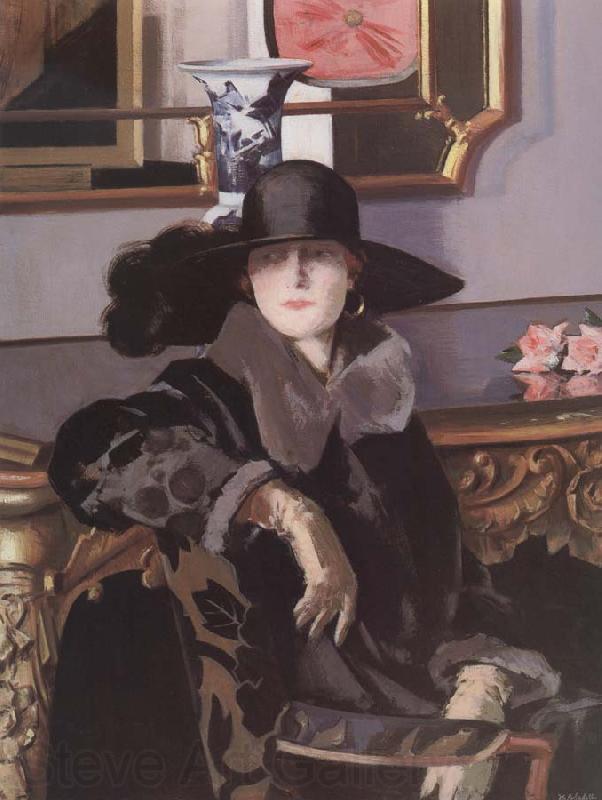
Jaysus, but I fucking hate them. 'Round these parts they're meant to be wonderful and innovative and everything. Well...I'll admit that they were technically accomplished, but innovative they were not. In fact, they were a thoroughly reactionary school, churning out their sub-Millais, 'kaleyard' pictures of romantic peasants, as seen here. I mean...Fuck. Off. Some of them were inspired by the way Cezanne painted light. I'm sure it would be lovely to pick cabbages in the climate of Southern France, if cabbages grew there. But, sorry, now matter how hard you squint, Dumfries and Galloway ain't Provence. (It goes without saying that my objections are as much political as aesthetic).

And then we come to this one. There's a fuzzy line between 'The Glasgow Boys' and 'The Scottish Colourists'. Whatever. But anyone who's ever visited the Kelvingrove with me, and many who haven't, will be aware - will have been told forcefully - that this is my very least favourite painting of all time.* I loathe it with a passion. Jesus fucking wept - I'm allergic to pseudo-Celtic mythology at the best of times, but this is just taking the piss. No need, no need. 'Bringing home the Mistletoe', I ask you. And it's huge!

I really don't know what it is about these fellas and why they're held in such esteem. I guess there's an inevitable tendency for provincial cities to idolise their own, 'World Famous in Glasgow' etc. etc, and since these guys were working at a time when Glasgow was the Second City of Empire (and fifth largest city in Europe), maybe they made a dispproportionate splash simply by dint of Being There. Because - their technical prowess admitted - they really aren't that special. Are they? Where's the originality? Where's the depth? Where's the Art?

The thing is, though, that Glasgow has produced its own innovative artists (as have many other cities). I'm a fairly recent re-convert back to Charles Rennie Mackintosh. I'd become blasé about him due to over-familiarity and the ubiquity round here of piss-poor rip-offs. But then you see The Glasgow School of Art** and see the way he uses Japanese references the way a contemporary artist might use Manga or Super Mario, all mixed up with Scottish vernacular, Gothic and Arts and Crafts. Plus he really does have an international reputation. On a recent visit to The Hill House I learnt that one of his tables was once owned by Andy Warhol***.

Plus Glasgow has its own, thriving artistic scene, as do many cities, and crucially one that's not regarded as a stepping stone to London or New York, but as a thing in itself. International artists are attracted there (and not in the same way as they are to Edinbugger where they arrive en masse to choke off the local culture). There's a sense of making local-but-not-provincial art. Elderly Glasgow pedestrian Alasdair Gray put it well: "Work as if you live in the early days of a better nation."

'Fraid I don't get any of that from these boys. Any Fine Arts course can teach the rudiments of painting, and their 'Glasgowness' was merely incidental. It seems to me that their chief skill was to be born wealthy enough to go to art school and settle into a career turning out chocolate box interior decor for their own type.


FULL DISCLOSURE: At home we have this and this on the wall and are looking for a frame for this. Harrumph.


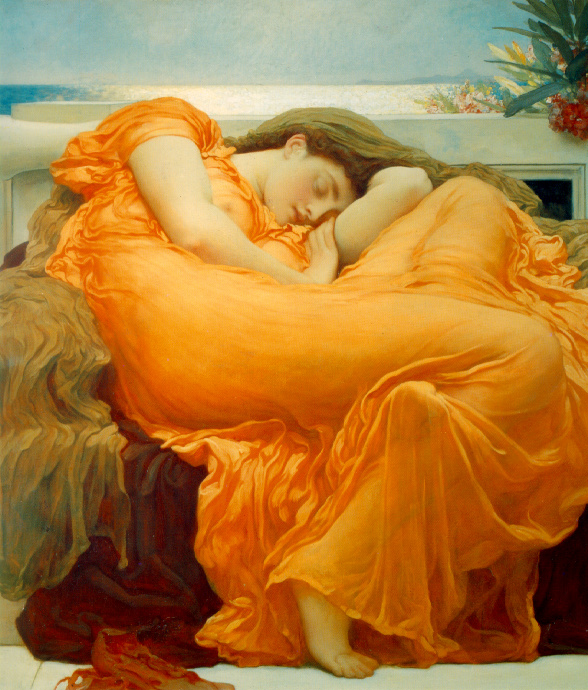
* With the possible exception of Frederic Leighton's 'Flaming June'. Or anything by Edward Burne-Jones or Lawrence Alma-Tadema (especially this piece of crap). In fact, any of that Pre-Rapahelite scheisse with all it's pictures of dopey, swooning women lying around - often in harems or the like - being all lethargic and available. (apologies to JE if she reads this. ;-) )

** Alex Kapranos of Franz Ferdinand once taught at GSoA. For those who haven't heard my story, I was in a bar a while back and the guy next to me waiting to get served was a skinny guy, beige jacket, stripey top, floppy hair. I turned to him and said 'Either you're the world's biggest Franz Ferdinand fan, or you are Alex Kapranos.' 'Can I just stop you there?,' he said, 'I'm Alex Kapranos.' Oops.

*** National Trust for Scotland properties have old ladies in each room, as guides. Ours told us about the table and said. "Mind you - I wouldn't even know what Andy Warhol looked like." Ah, what a terrible thing esprit d'escalier can be. We were half way home before I realised I should have told her "Andy Warhol looks a scream." See also this previous post.