One bonobo's view of the world...and stuff.

Tuesday, October 31, 2006

Wooooooooooooooooooooooooo!

Nothing to say...except to give a quick cross-link to Pumpkin-a-thon '06.

I have a Hitchens/ Iraq body count posting in preparation, but I've been too busy carving pumpkind. And sewing a dragon costume.

Wednesday, October 18, 2006

...and it's a fuckin' ugly head

Welcome to my first 'Guess The Relevance Of The Accompanying Image' competition.

So anyway…on the way to work yesterday, I stopped for petrol at a supermarket (I’ll not mention which one, but if you were to assume that it was whichever one first comes to mind, statistically you’d have a good chance of being right.). When I went to pay, there was an East European lorry driver at the counter trying to get directions – the supermarket is brand new, and he’d fallen off the edge of his GPS. He was getting nowhere in sign language, so I asked him if he spoke German – which he did, some – and pointed him in the right direction. After he’d gone, I paid for my petrol, and the woman serving engaged me in conversation:

“Where was he from?”

“I’m not sure. I think it was either The Czech Republic or Slovakia.”

“Hmmph. See if you went to one of their countries? Nobody would be friendly like that. They wouldn’t give you the time of day.”
(Sigh! Always give them a chance to be educated, though).

“Oh, I don’t know. I’ve always found the people very friendly over there.”

“Aye – but see on our estate? They get all these houses for the Russians, and the council pays for it all, and they just fill them with prostitutes…”


I turned on my heel.

“Tell you what – I shouldn’t have to listen to racist garbage like this on my way to work.”

“I’m not a racist.”
I turned and gave her my steeliest of glares.

“Yes you are.”

If it walks like a duck and quacks like a duck…then it probably hasn’t spent enough time in the microwave. But isn’t this kind of run-of-the-mill stuff just soooo tedious?

When I got to work, I phoned the store manager. Give them their due, they’ve taken it seriously and I’m confident that certain working practices will be explained.

As Jeremy Hardy said the other week:

“You have to sympathise with racists these days – they’re having a hard time putting across their point of view: ‘These immigrants – they come over here with their white faces and bland food and fit thermostatic valves to our radiators.’ Hardly has the right force, does it?”

Monday, October 16, 2006

Never return to a god once lit.


More of the headline story in a minute.

First of all...

There has been a pernicious rise in religious extremism of late. The Minister for Women and Equality, Ruth Kelly, is responsible for nursing through the Equality Act, which aims to outlaw discrimination in the provision of goods and services for the LGBT* community. She is also a member of the crypto-fascist Catholic autoflagellant group, Opus Dei. The bill has already been delayed due to meddling by religious groups, and Kelly is pushing for exemptions for faith-based groups. This has caused rows in the cabinet, but she is being supported by Tony Blair, an in-yer-face Christian who is widely rumoured to be a Catholic convert. More information here and here.

Obviously one gruesome aspect of this is the grubby homophobia that so frequently goes with religion. But as a certain George O'Dowd once said, "If God didn't want men to shag each other up the arse, then why did he put the male clitoris up there? It must be some sort of divine plan."

At an even more basic level, I fail to understand why the religious might think they have a special right to be exempted from democratically-agreed laws. This law is intended to limit the effects of individual bigotry on others. What Kelly and her ilk are saying is "Ah, but our bigotry is divinely inspired."

Shit on 'em.


* Sorry - but this always comes out as "LGBLT". My bad!


But back to the title....

I don't usually 'do' religious ceremonies, obviously, but at the weekend I was fortunate to be a bystander at a Hindu ceremony for Dussehra. It marks the triumph of Rama over the 10-headed god Ravana - or the triumph of good over evil. It's conducted around sundown at a time considered to be a new start. First of all we watched a (much abridged!) enactment of the Ramayana in which kiddies in brightly-coloured costumes and monkey tails (Rama's army of monkey soldiers, see?) rescued Rama's wife Sita from Ravana. It was a lot more exciting than yer average nativity play, involving much charging back and forth and brandishing of toy swords. (One of the monkeys had a light sabre!). This was accompanied by evocative hindu hymns, drumming, rhythmic clapping, a pandit spraying the crowd with scented water, and much blowing of a conch shell. Then, as night fell, they torched a giant papier maché effigy of Ravana and let loose with the fireworks. By this time we'd wandered over to a small hill overlooking the site, so we were on a level with all the crackles, pops and wheeees. Only a few shells landed near us.

If you must have religious ceremonies, then let 'em involve fireworks, I say.

Wednesday, October 11, 2006

There's always an elephant in the room.


Yesterday was National Mental Health Day. Alistair Campbell was on R4's PM show talking about his history of depression. Fair play to him - he discussed it openly and without stigma. He said that it would be unsurprising that leading members of the government were to suffer from mental health problems, given the amount of pressure they're under.

I wanted Eddie Mair to ask him the obvious question:


"How did you feel when a government advisor was put under so much pressure over remarks he was reported to have made about you that he walked into the woods one night, took a handful of pills and slashed his wrists?"


(The picture is a reference to the Peter Capaldi character in a satirical TV show that currently has as much chance of being repeated as Gary Glitter has of doing a comeback tour.)


Favourite Eddie Mair moments:

  • His opening headline on the day the British government had been accused by Gerry Adams of covert surveillance in Stormont: "Sinn Fein say, 'The British government are buggers'."


  • When he asked the Sudanese ambasador, "How do you sleep at night?"


  • When Elton John won a libel case: "We've just got time to read out one more listener's e-mail. Mrs Jones of Basingstoke writes, 'That Elton John - he's a great big poof.' Goodnight."

More of his wit and wisdom here. He's better than that twat John Humphrys any day.


I've a new photo on my Flickr site. Enjoy!

And while I'm doing quotes from the good and the great...here's a bunch from John Peel.


Friday, October 06, 2006

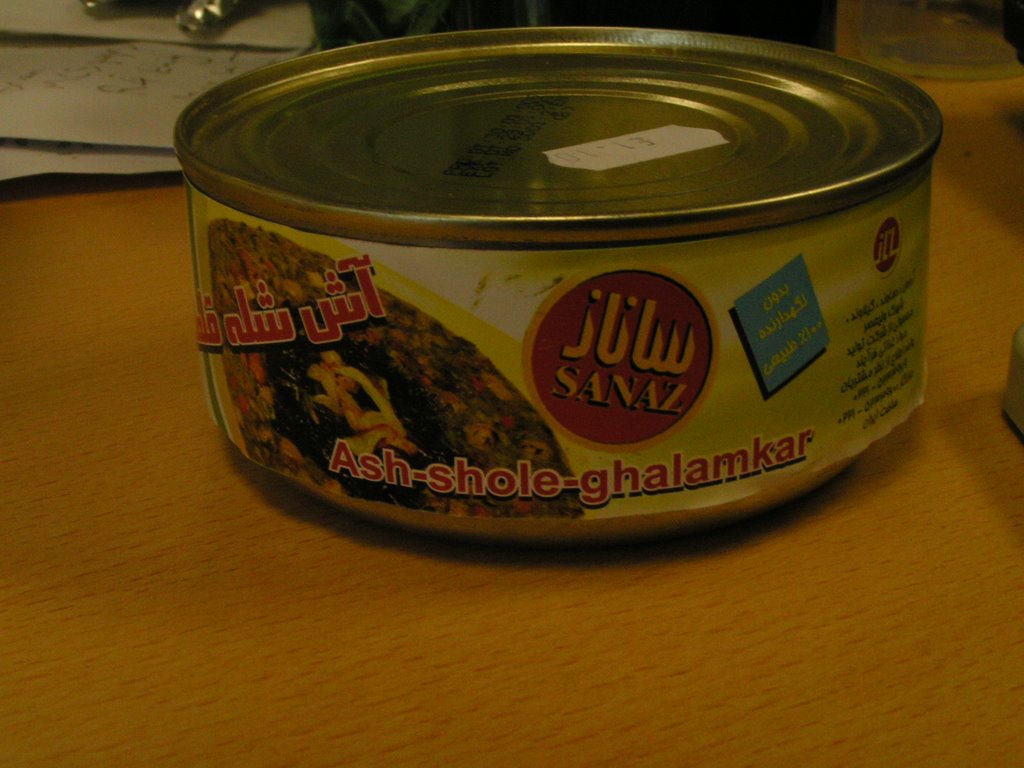
I never knew they did them in tins!


Jen-yoo-wine purchase from my friendly neighbourhood Iranian food store.

(fnarr, fnarr)

Friday, September 22, 2006

Death to Thomas Szasz

A brief interlude before I get back to animal rights. I'm much more interested in our particular type of animal.

I was talking with some people the other night about a legal case that one of them had heard being discussed on Radio 2. A woman had swallowed a load of pills to kill herself and then phoned up a friend and asked him to sit with her while she died. He did so, and has been charged with being an accessory to murder.

The talk turned to whether one is duty bound in such circumstances to intervene by calling for medical help. It somewhat surprised me, given that all people in the room had recovered from episodes of serious depression, that there was some doubt. The argument given was that while they had survived - in large part through the support of friends and family, another person's situation might be so lonely and desperate that they might never get better. And psychiatric services are notoriously hit and miss. Some get an excellent service. Many more fall through the cracks. In such circumstances, since the pain of depression is so severe, it might be cruel to force them to live on.

My counter to this is that we simply don't have the information to make an informed judgement from case to case. We might assume that they won't get better. We might assume that they will never get social or medical support...but we simply don't know. Nevertheless, we have to decide one way or another. My own position is that I would want to be saved. So if someone tells us they're planning on suicide, we call a doctor as a reflex action.

Some notes:

  • I don't blame the guy. He was trying to do the right thing. He was wrong.
  • Suicide is not a cry for help. It's an expression of pain. Suicides want to kill themselves.
  • It's futile to try to identify a cause: "What made him do it?". The answer's "Everything" or "Nothing" or "Bad chemicals on the brain." It's an illness. Call an ambulance!
  • Assisted suicide in the case of nasty, terminal, untreatable and humanity-sapping illness is a different matter. In the case of something like Motor Neurone Disease or Huntington's Chorea, we do have enough information to go on. Individuals should be allowed to choose their fate.
  • Who's Thomas Szasz? The most dangerous psychiatrist wever - with the possible exception of Radovan Karadžić.
  • In all discussions such as this, I am duty bound to post contact details for The Samaritans. If you have come across this post, are feeling depressed and are thinking of harming yourself, Contact them right away. They're there for you.. If you know somebody else in this position, please do your best to get them medical help.

Sorry to, like, totally bum everyone.

Wednesday, September 13, 2006

We do (doodley-do) what we must (muddily-must).

"It's Just God's way of punishing them for being dumb?", Pt 2

Yesterday I took a swipe at Animal Rights. Today I'll try and say something about what I think constitutes a suitable foundation for ethics, based on a rationalist, human-centred viewpoint. Next time I'll be saying a bit more about what this means for the poor defenceless bunnie-wunnies.

I'll try and be as coherent as I can here...but note point 13.

  1. It's a cold, impersonal universe out there. God, Mother Nature or whatever don't give a flying fuck whether we live or die. Our survival, as individuals or as a species, is not guaranteed. In the grand schemelssness of things, our pain or suffering does not matter. It follows that 'good' or 'evil' are not transcendental or absolute concepts. There's no natural order to the way we must behave. We can't deduce it by looking beyond ourselves.
  2. Ethics relate only to how we behave as humans. A tsunami killing thousands or a dingo running off with a baby may be 'bad', but they're not unethical. As far as we know, non-human animals are incapable of making ethical choices about one another, but that's their business anyway. We can't change it. The only sphere we have any control over is our own behaviour.
  3. There are many different types of human, with vast intra-species variation and differences in physical function (young/old; sick/healthy). There is no basis for differentiation in the rights of any group. Further...there is no basis on which to judge the superior worth of any human, be it on grounds of ability to do sums, a good singing voice, height, girth, wealth or attractive breasts. The same ethical status should be applied to anyone with human DNA in their cells.
  4. Humanity is a biochemical phenomenon; we're bundles of DNA that got lucky. It is inherent in our nature that we will seek certain things (call these 'pleasure' or 'bad') and avoid others (call these 'pain' or 'suffering' or 'bad'). These are broadly related to gene tranmission since we tend to survive if we seek gthe things which are good for survival and tend to perish if we fail to avoid things that are likely to kill us. Pathology apart, this is how always behave. This isn't the same as saying that pleasure always equates to things related to breeding (although it often does!), simply that we have a pleasure seeking/ pain avoiding mechanism built in to us. All animals are the same, at least as far as avoiding injury or death. As any typesetter will tell you, Cicero put it well:

    Neque porro quisquam est qui dolorem ipsum quia dolor sit amet, consectetur, adipisci velit. (There is no one who loves pain itself, who seeks after it and wants to have it, simply because it is pain)

    So I think it's reasonable to say that 'Good' = the things we like and 'Bad' = the things we don't.
  5. A significant human quality which affects our happiness is our ability to empathise. Certainly, while some can kill and feel no emotional trauma, a reliable source of pleasure is the company of loved ones (or, for some but not all people, animals, especially cute, fluffy ones that invoke nurturing responses). On the whole, a lack of empathy is 'A Bad Thing', so it is reasonable that we should be guided by our nature.
  6. As individuals we have a degree of choice (within environmental constraints) as to what we want to do. Granted it's a bit more complicated than this and sometimes involves long and short term tradeoffs (I want that chocolate vs I want to get slim; I don't want my husband to hit me again vs I'm afraid I won't be able to support myself without him; etc) . So it's reasonable to say that ethics should be based on a right to avoid pain and pursue pleasure as best we are able. (Although in a complex world we're not always able to make straightforward, reliable choices).
  7. So far, so Ayn Rand. But we are interdependent herd animals. In a community, it would defeat the pleasure/pain principle if we were all allowed to do whatever we wanted at any given time, regardless of the consequences for others. Imagine you were one of the weaker members of the community...or a strong member taken by surprise. So "Do as thou willt" shall not be the whole of the law. It needs to be qualified by accepting that just as the individual has the right to avoid pain and pursue pleasure, so has every other individual. Ethics requires this recipricocity.
  8. So, a judgement as to 'What is right' has to be based on some form of community consensus. At various times in history, such consensus has been imposed top down, democratically debated...or just simply is - but it's not important to talk about that here. In any case, Ethics is based on what we mutually agree is, by and large, on the whole, good for society at large.
  9. We can't always trust our own judgement, as individuals or as communities. Some problems need to be thought through rather than leaping to simplistic conclusions. It is useful to have specialists appointed - judges, ethicists - who have the intellectual equipment to do so.
  10. The consensus will always evolve. Leaving newborn infants on rubbish heaps? That was fine for the Romans. Imprisoning homosexuals? That was what we did in the UK until the 1960's. We might deplore the behaviour of those in times past, but there's not a damned thing we can do about it...other than behave differently in our own time and try to convince others to do the same.
  11. Ethics are situationally dependent. On the whole, it's probably not nice to cast the elderly adrift on an ice floe...but if there's not enough blubber to feed everyone...
  12. Sometimes we won't have a bloody clue what's the right thing to do. And sometimes we'll get it wrong. (See my previous comment on The Law of Unintended Consequences.) This should come as no surprise because a) It's a complex world and b) There are no set standards to guide us. So we just have to do our best. This does not necessarily mean that we can just follow our gut instincts or we can be lazy about thinking through alternatives. But sometimes we're going to just have to do what we do and not know whether we've done the right thing.
  13. At any given time there will be disagreement as to what is right and what is wrong, and on how to behave and structure society to deliver good. There's no way around that. One way out of it is to let the rules be defined by an arbitrary autocrat. It seems more sensible, though, to evolve towards a consensual, democratic system with a safety net of tolerated dissent. That's what gets my vote, anyway...even if the outcome isn't always what I'd want. There still remains a problem with those who might flout the consensus and behave badly. The best we can do is to grant democratic institutions the powers to deal with them.
  14. It will always be a bit of a fudge. Individual needs and opinions will differ. And we can't always be certain that we're doing the right thing...after all, there are no absolutes to guide us, and the universe doesn't give a fuck anyway (see point 1). We just have to do the best we can with our puny brains.

That's enough rambling for now. Some applied examples:

  • Allowing homeowners to shoot people for trespassing on their lawn leads to a dangerous, fearful and unhappy society. It shouldn't be allowed.
  • Killing the infirm shouldn't be allowed. You or I might get sick too. Plus by routine killing we reduce our empathy.
  • Abortion is troubling for some but not for others. Those who wish their fetuses to mature into viable humans should be helped to keep them. Others are perfectly capable of disposing of an unwanted fetus without becoming hardened by it.
  • In my subjective judgement, some perfectly tolerable, decent, humane people eat steak. No matter how they're reared, moo cows don't like being slaughtered

Tuesday, September 12, 2006

The right to arm bears

“It’s just god’s way of punishing them for being dumb.” Part 1.

This post is a tirade against the very idea of animal rights – which I think is based on some sloppy sentimental thinking. In particular, It’s about the Ideas of the philosopher Peter Singer, who is regarded by some as the founding father of the Animal Liberation Movement. …Although perhaps he’d be less in favour if the guys actually listened to him or read his books. He regards suffering caused against animals as morally equivalent to suffering in human, so on that basis he doesn’t believe we are justified in eating them. Fair enough. However, as a Utilitarian (he calls himself a Consequentialist) he maintains that the benefit of many can justify the suffering of the few, so he’s not, in principle, against animal experimentation. But he would regard a newborn baby as ethically inferior to an adult primate and so would advocate experimenting on the baby rather than the monkey - with the obvious benefit that a human subject would provide a better medical model.

Here are some reasons why I think he’s wrong:

  • The whole notion of Utilitarianism is rendered bankrupt by the Law of Unintended Consequences. We can’t reliably tell whether our actions will lead to good or ill (what if we kill a baby Mandela to save a baby Hitler…etc. etc.). Thus we must only make such utilitarian decisions in extremis – such as shooting down the airliner just before it hits the building – and even then only if we can be sure it’s not going to plummet into the crowded city. (There’s a flipside to this in medical research: We can never be certain that by inserting the probe in the monkey’s skull we’ll cure Parkinson’s disease – but I think there’s an answer to that - more in a future post.). And then there’s the paradox of how we measure’ good’ across populations: Maximum? Mean? Mode?
  • Singer has spoken of ‘speciesism’ as being equivalent to racism, sexism or any moral distinction between humans. This is a key quote for Animal Rights advocates - it gives them a spurious high ground. His argument for the equivalence of humans and animals is based on the idea that we are indistinguishable from animals – we are simply a type of Great Ape. This is true. We share our DNA, in varying degrees, with bonobos, dogs, snakes, slugs, fruit flies, bananas, slime moulds. But from this reduction ad absurdum it’s pretty clear that a line has to be drawn. Singer draws it at the capacity for suffering and/or enjoyment or happiness. So humans and gerbils have rights, bananas and boulders don’t. Oddly (to my way of thinking), he’s not an absolutist about this. He allows a continuum based on the extent to which organisms have unmet goals. So a newborn baby, who hasn’t yet developed goals, or an infirm elder who’s met all the goals they’re going is less ethically important than, say, a bonobo or (I’m not clear on this) a mouse. And, perhaps quite reasonably, there’s a continuum from grown-up humans down to jellyfish. Hmm. I wonder how you measure an organism’s capacity for pleasure/pain . I’m not convinced by people who tell us authoritatively that fish/lobsters/shrimp don’t feel pain; I just don’t think we know. And I’m damn sure we can’t quantify it. But even if we could…how many lobsters would be equivalent to a human? What’s the exchange rate between lobsters and mice? I’m thinking it’s an all or nothing thing.
  • Singer is selective about the rights that he grants to animals. He focuses on their suffering but does not think, for example, that armadillos should be given the vote. So let’s focus on life, freedom from suffering and self determination (which, I guess, would translate in practical terms as the right to roam free). To take the last one first – all animals compete for resources. If there’s not enough nuts in a wood, grey squirrels will survive at the expense of red. Do mice and rats have a right to nibble at our soybeans or birds to eat all our cherries from the tree? Maybe – but I think it’s quite in order to deny them that right and keep the food for our own species. Then…life and freedom from suffering. Well, animals don’t afford us those rights, do they? Presumably, though, given a continuum it’s in order for us to shoot a leopard who’s about to pounce on a human. (But what about a baboon who’s about to fatally injure a baby?). However…they don’t even grant each these rights. But are we in order to shoot a leopard who’s about to pounce on a zebra? Or a human who’s about to shoot a zebra? Or a leopard? Or a bonobo? It seems to me that human moral capacity must fit into the equation somewhere and that humans have a different ethical status to animals.
  • Ethics fundamentally deals with issues concerning how we deal with one another, and Singer would extend this to animals. I think that all but selfish ‘Objectivists’ of the Ayn Rand school (I object to her use of the word ‘objective’ - and thanks to healinmagichands for pointin out an error in my original post) would accept that we have a duty of care towards one another. So, for example, it is morally good to feed the hungry and tend the sick – not that we do enough of these. Should we be expected to extend this to animals? Need we scour the jungles in search of sloths in need of medical attention? Should we have lifeguards on beaches to throw back beached jellyfish?*

In short, it seems to be that Singer's ethical framework is somewhat irrational. Taken to the extreme, it would have thoroughly objectionable consequence for humans judged to be less sentient.

For the record - I don't eat animals.

Eventually in Part 2 I'll expand on (my version of) human-centred ethics.


* A man is walking by the beach. He comes across another man who is walking along the high tide line, picking up jellyfish, placing them in the sea and wishing them luck with a cheery wave. He approaches him. ”What are you doing?” he asks. ”Im rescuing jellyfish”, the man replies. ”But there are thousands of them. How can you possibly make a difference? The man places another jellyfish in the sea and bids it farewell. “Made a difference to that one, didn’t I?”

Thursday, September 07, 2006

Fancy a quick marriage, hen*?

Sometimes you come across something that makes you realise that public perceptions are not the whole truth.

In this vein...I've been reading up on Sharia Law. This, as I'm sure you'll know, is the various systems of judisprudence followed by Muslims. There are various in different countries and/or followed by various sects, each depending on the weight they give to the aHadith, sayings, customs and practices of the prophet (peace be upon him), as reported by whichever scholars they pay attention to.

Anyway - I was struck in particular by concept in Shia sharia (the Sunnis don't buy it at all) of Nikahu’l-Mut‘ah - Temporary Marriage. Unlike in full-blown marriage, here the marriage contract includes an expiry date. Because of various other provisions, it allows for a good deal of pragmatism:

  • It is a matter between individuals (although Iranian law requires requires registration of temporary marriages).
  • Women are not bound to their husband's wishes, but may go out and work, if they wish.
  • Property rights aren't included - so women can inherit.
  • It is mustahab (recommended, but not compulsory) that the marriage contract is extended on expiry. Isn't that a great legal concept, 'it would be best if...'?
  • It can be used as a trial period, prior to marriage - much as we do, but with obvious benefits for arranged mariages.
  • Many couples choose 99 year contracts in preference for full marriage, because it gives more freedom to the woman.
  • It allows marriage between a Muslim and a Christian or Jew (but not with kaffirs - people who are not 'Peoples of the Book' ( Ahl al-Kitab)
  • It can be contracted when men and women are going to live under the same roof but not as a couple, when it would be convenient to relax the rules relating to hijab.
  • Get this...It is allowed even if it's solely for the purpose of sex! I've read that in Iran, mullahs hang around popular meeting places with printed contracts ready to go...and that they also sell condoms.

Of course, I of all people** am the last to defend any religion. I think that law should be based on secular principles...and I don't see why it has any business interfering in consensual relationships between men and women, other than to ensure that women aren't exploited. But it does show that the picture we receive of Islam as an inflexible monoculture is somewhat far from the truth. The Middle East is, in certain repects, as pragmatic and pluralistic as any region, in a "I didn't know the dog was a Catholic" *** way. And Sharia Law isn't just about chopping thieves' hands off, any more than Western secular law is about banging people up in Belmarsh on a pretext or ASBOs whereby police officers can invent the law as they go along.

* For non-Scots readers, hen = darlin'. But men are rarely refered to as cock.

**Militant Atheist Fundamentalist, leaning towards calling myself a Bright.

***Auld Mrs Murphy's dog dies, so she goes along to Father O'Toole and asks him to arrange a nice wee funeral. "Now, Bridie," says the priest, "You know that funerals are only for people. Animals don't even have immortal souls. I can't go saying a funeral mass for an animal!" "But," says Mrs Murphy, "I'd be prepared to make a sizeable donation to the parish - in cash, too." "Ah, now," says Fr. O'Toole, "You never mentioned that the dog was a Catholic.."


The Grauniad on the ENO/ADF Ghadaffi yapera (See Skinheads, apostrophes and choonz post) Or, from al-Jazeera, here.

Tuesday, September 05, 2006

String 'em...along!

The attempted suicide in prison by Ian Huntley and the previous successful suicide by Harold Shipman raise some interesting ethical/penal posers, including-but-not-limited-to:

  1. I presume there will be many who will shout 'Let the bastard die!' I admit I haven't done the full research, but I imagine there will be a high correspondence between these and those who would have wished him to have been hanged rather than imprisoned. Interesting. Presumably capital punishment is favoured because it is the worst imaginable punishment. And yet Huntley seems to have preferred death to imprisonment. Would the pro-hangers be happy for him to be slipped a couple of pills and allowed to choose the time of his death?
  2. Some in the anti-psychiatry movement, such as Thomas Szasz (imagine the triple word score!) argue for 'the right to death' - i.e., even in cases of mental illness (whose existence they deny), individuals have the right to suicide. (Contrast this with Article 3 of the Universal Declaration of Human Rights). Obviously we already deny some rights to prisoners - but is it acceptable to deny this right? (If, indeed, it is a right)
  3. Still on psychiatry/anti-psychiatry. Obviously there are cases where an individual chooses suicide, arguable as a rational alternative to imprisonment. See this case. Or think of Butch and Sundance. But how can we distinguish this from a suicidal urge brought about from clinical depression which results from life in prison? Is it right to err on the side of caution and assume that prisoners will change their mind, given proper treatment? Of course - treatment is unlikely to be reliable and, given the circumstances, be palliative at best. But then the same applies to many depressed people living in desparate life situations. Should we just hand them the pills?
  4. Is life imprisonment fundamentally a cruel and inhumane punishment? In the case of US Supermax prisons, I'd say 'Yes'. They seem designed to induce suicidal depression*. Of course, the US has notoriously grim prisons by worldwide standards. I read a quote a while back to the effect that, to all appearances, male rape is an officially sanctioned part of the American penal system. Surely people are sent to prison as punishment, not for punishment? So...as a civilised society (there's a massive assumption!), what level of comfort are we happy with for convicted criminals?

Tricky blighters, ethics. I'm not sure there are ever any clear-cut answers.

*But of course attempted suicides at Guantanamo are sneaky attacks.

Monday, September 04, 2006

Skinheads, apostrophes and choonz

Disappointing

I finally got around to watching American History X at the weekend. I’d heard great things about it, and especially about Ed Norton’s performance. I have to say, I was…underwhelmed. It seemed to me to have ‘Made For TV’ production values – right down to its thick layer of cosy schmaltz. What particularly disappointed me was the lack of any nuance in the character arcs. So the basic plot seemed to be ‘Guy becomes a skinhead because he’s a bit mixed up after his father’s death…goes to jail…gets friendly with a black guy and changes his mind…but just too late to save his brother (who’s also had a change of heart, thanks to a kindly black teacher). And the Norton character…he simply appeared to be pleasant enough, articulate guy – albeit one who trashed grocery stores and shot people. The only development he went through was that his hair grew back. And where did the plot line about the teacher's seminars disapear to...other than the brother's unexplained take on his essay.

I’m sure there’s a great film to be made about American extremists, but this ain’t it. SE Hinton does this kind of stuff much better.

(Shame. I really rate Norton. For a much better performance, see him in the criminally overlooked 25th Hour)

Mind Yer Langwidge

This in yesterday’s Observer: Author takes on the queen of commas – about counterblast by linguist David Crystal to the self-appointed Language Police. What really got my goat was a quote from that reactionary humbug, John Humphrys.

'I think David Crystal is making a fundamental mistake when he says rules don't matter that much. I say they matter enormously. Take the example we always use on both sides of the debate: the apostrophe. It is either right or wrong. We wouldn't accept something being wrong in any other walk of life, would we?'


This is certainly true when we are dealing with something important - say, how to build a nuclear power plant or which side of the road to drive on (sic). When, however, the breaking of a rule has no other consequence than to upset the pompous (eg, which knife to use for fish; how to address a bishop; where to put an apostrophe), it is mere convention.

Seriously, though...can anyone think of a set of circumstances in which a misplaced apostrophe might lead to harm?

Giving ‘Poddage To…

The new Dylan
Asian Dub Foundation
Polly Harvey

…and in the ‘a bit silly’ corner:
Mieskuoro Huutajat. Shouting men from Finland. Check out their ‘Star Spangled Banner’ under Audio.
The Thurston Lava Tube. Named after a Hawaiian geological feature. For those who like their Beatles with extra cheez.
Apocalyptica. A Finnish string quartet who play stunningly excellent Metallica covers (sample available via the link).

Monday, August 28, 2006

Feathery limbs in leathery Lambourne

Since azahar has taken the wind out of my Pope post...

Today is the centenary of the poet John Betjeman's birth. God, how I loathe his tedious, sentimental, bafflingly popular doggerel. I don't think it's just because we studied him extensively at school - a soft option for O Levels - because I like some of the other ones we did (RS Thomas, Dylan Thomas, Larkin, Hughes, Owen, Sassoon). What annoys me most - apart from his facile dum-de-dum metrical scheme - is the way he's held up as an exemplar of 'Englishness'. It's not a kind of English I've ever been a part of.

I admit that I don't read much poetry, but I've been trying to read more lately. I've bought the collected works of Norman McCaig (excellent!) and TS Eliot (I really must make a stab at The Four Quartets and The Wasteland again). In the past I've liked Yevtuschenko (who I once met), Ginsberg, Langston Hughes, Whitman, Stevie Smith, the Merseypoets (McGough, Henri, Patten), Burns, McDiarmid, Yeats, Heaney.

What poets does everyone remember from school? Did you like them? Did they stick in the mind? Or where they just a boring waste of a period of your life?

The Pope vs Darwin

Pope Ratzo is to reevaluate the Catholic church's position on Intelligent Design. (see here). The Polish guy said that evolution is 'more than hypothesis', and I understand that the official position is (something like) 'God created evolution.' But this sows more doubts than it assuages.

Now Ratzo is moving towards (so-called) Intelligent Design - the theory that God has a hand in every single fruit fly mutation. I can see why he'd want to lean that way: If we can explain The Origin Of Species without recourse to a supernatural entity, the whole edifice comes tumbling down.


Isn't this one of those examples of casuistry - the Jesuitical art of arguing that black is white? If it's not true, then all of Catholic doctrine is untrue, therefore it must be true because everyone has to go on believing.


Friday, August 25, 2006

Why I hate DIY

In Human Factors/ Ergonomics, we sometimes talk about ‘Maintenance Induced Latent Errors’ – that is, when someone’s fixing something, they make a mistake which is not noticed at the time but which later has disastrous consequences.

This is why I hate DIY.

So…I get a desperate phone call from home yesterday saying the washing machine’s broken. As soon as I get home I go to fix it – the start button has slipped back and got jammed behind the fascia. (By the way…this was my second repair of the week. Last week I had to put the drive belt back on. A charlatan of a repairman tried to sell us a new circuit board!). To get at the buttons I have to get the top off the machine, which meant pulling it out from the kitchen units. This proves difficult, because one of the legs has come off and it keeps on jamming on a gap in the flooring, and I end up having to pull the tumble drier out also to get at it – which means untaping the vent hose from the duct in the wall. Anyway – I do all that, and fixing the button is a doddle (Couple of screws for the top cover, unclip the circuit board, clip the button unit back into its mounting – repeat in reverse). Then all I have to do is re-tape the tumble drier hose and put it back…But the washing machine is still hard to budge, so I decide to fix the leg back on (by a miracle I know it’s in the cutlery drawer). This means tilting the machine on its side and simply screwing the leg back in. Problem is – I can’t tilt it because it’s constrained by the feed and drain hoses and electrical cable. So I unplug it, unscrew the jubilee clip on the drain hose under the sink and turn off and unscrew the feed hose from the water supply (with a minor panic when I find there’s a second, old and disused hose which I inadvertently turn on, causing a minor flood). Anyway…I do all that, on goes the foot, I slide the machine back in place and connect everything up again. By now my work clothes are filthy and partially soaked (never mind – dress down day tomorrow), so I go upstairs and change. Then I go back into the kitchen to make a cup of tea, and while the kettle’s boiling I notice there’s some dishes in the sink basin. So I tilt the basin to empty out the gungey solution of yesterday’s rice…Strange…Why are my feet so getting wet? Yup, you guessed it…I’ve forgotten to refit the drain hose from the washing machine and the sink is draining through where it’s meant to go. And, of course, the hose has been pulled out of the kitchen cabinet so I have to pull the machine out to get it.

But that’s just a simple DIY job. Suppose, though, that it’s a complicate chemical plant of the cooling system of a nuclear reactor. Do you reckon they’re any better? I’m afraid to have to tell you that experience suggests not.

Thursday, August 24, 2006

Does anyone else do this?

Say I'm going out to the car to go buy milk or beer or something. I pat my pocket for my wallet...not there. I go to the kitchen and look on the countertop. Nope. I probably left it in the car. But then my mind leaps ahead. What if it's not in the car? I might have left it at work? Is there anyone still there who I could call? Or maybe I dropped it at the last supermarket I was in? I'd have to call them up and then go get it - but that would take time and I've got X, Y and Z to do. Hmm...what's my plan B for those? And, damn, it's got that phone number for suchandsuch, and if I don't phone tonight I'll have to do X, which means Y...Oh! There's my wallet on the car seat!

What a stupid fucking waste of mental energy! I could have been using those brain cells for...ooh, something. If only you could donate spare brain capacity to seti@home.

Günter Grass

Günter Grass has long been one of my literary and political heroes. Following his revelations about his Waffen SS past, I've been trying for a way to let him off the hook. I have to say, though, I kinda agree with this article by Christopher Hitchens. My initial reaction on reading was to fulminate - but I think he makes his argument well. Not sure I agree with his literary judgement, though.

Elsewhere on the web

What to do if you want snakes on your plane.

Monday, August 21, 2006

Edinbuggering about.

I took a few days holiday last week before Sophie and Adam went back to school. Part of the time was devoted to buying a new car (and all the money stuff associated with that).

Once that was sorted, we went through to Edinburgh. I bought a really cool kalimba (aka 'thumb piano') made from a sardine tin and we had lunch outside at a cafe in a church crypt. Here's a good Social Engineering idea: If mosques were to open cafes, they'd lose some of their scariness, they'd become integrated into the wider community...and the food would be brilliant!

The main purpose of the visit was to see the Ron Mueck exhibition at the National Galleries of Scotland. It's been getting a lot of press.
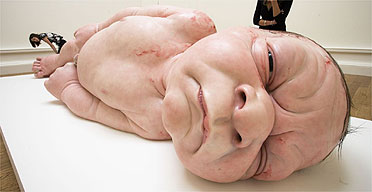

The baby is some 6m long. The spooning couple are about 14in and look as though they could stand up and dance. I'd've been damn scared if the baby had stood up.
This review here is pretty savage. It argues that Mueck's stuff isn't really art. A similar comment I've read is, 'All very clever - but then so is taxidermy.' I can see the point - there's a difference between the model-maker's skill in creating a realist representation and the artist's skill in imbuing it with meaning. However...I found that seeing the figures on such an enormous scale really made me stop and look at them. And surely that's what Art should do? Make you look? One piece was a baby at about half scale which was mounted on a wall. The unusual perspective shift was dizzying. It also works as sculpture. In some of the pieces the tension of the muscles and pliancy of the flesh was exactly right.

The Edinburgh Festival is in full swing, so we wandered up and down The Royal Mile, having flyers from fringe groups thrust upon us and watching street performers. A particularly impressive Swedish magician did a variation on the cup-and-balls trick...and I have no idea how he managed to sneak the melon under his hat.
We had the devil of a job getting out of Edinburgh. We never seem to take the same route twice. They have an...'interesting'... approach to signposting whereby you follow signs for Glasgow, then when you get to a particularly complex junction...they disappear. Or sometimes they say instead 'West' or 'North'. But how do you know which way the motorway is if you don't know where you are? And if you do know where you are...you don't need a sign. We came back via a somewhat convoluted route.

Wednesday, August 09, 2006

Doing my bit for global warming


As I've mentioned elsewhere, I'm temporarily green - using public transport to get to work on account of my car having been declared dead. The cost of repairs wouldn't be worth it.

God, I hate car buying. Thanks to a generous father-in-law, it turns out we can get something reasonably decent - so it's more or less a matter of just walking into a garage and saying 'Yeah, that looks OK.' So where's the stress? Well, I guess it's a matter of psychological and cultural baggage. Firstly, cars are meant to be a manly thing. But being a bit of a girly boy I neither know nor care about them and immediately feel at a disadvantage talking to dealers. Same as in pubs when folk talk about fitba. Then there's the whole sales negotiation thing. You're meant to show off your business acumen by getting a good deal. You go along with your Parker's Guide (the guide that tells you how much every model in every variation should be selling for), show that you know the market and have other options, walk away a few times, brazenly ask for £1k off, a free hi fi and a blow job...etc. etc. Frankly, though, the dealers are better at this sort of thing than I will ever be and I always walk away a) feeling slightly dirty and b) with a nagging feeling I've failed in my sacred duty not to be ripped off. I won't have been ripped off: I'll have a car that I'm content with and a loan I can afford.

For them's as gives a flying fuck, here are all the cars Cath and I have ever owned:
  • Cath's first car was a Ford Escort that cost about £200. She drove it about 6months, and then it went for scrap.
  • Then she got a lease car through her job - a Ford Fiesta.
  • My first car (we met on a residential driving course, and I was still taking lessons after we got together) was a Ford Sierra. When we moved to Scotland I didn't need a car and it sat outside our flat. There was a hairy moment when our street flooded and I had to start it up for the first time in three months (it worked...eventually...but the steering wheel had gone mouldy). I'd had a couple of self-inflicted bumps, so when I put it in for pre-selling insurance repairs, it was declared a write-off (soI got a better price than I otherwise would have).
  • Meantime, Cath had bought a VW Polo. That kept going for years...although for the last three or so the throttle return mechanism had been operated by a complex system of external springs and bailing wire. (Remind me to tell you that story).
  • About ten years ago we bought the Fiat Tipo (the one that's just been declared dead)
  • Three years ago we bought a very suburban Renault Scenic.


The advantage of getting to work by train/bus is that I can read and listen to my 'Pod. My current book is The Folding Star by Alan Hollingshurst. I'd had it on my shelf for years after a friend recommended it. It's utterly filthy - lots of hot man-on-man action - but rather good

I also get to read the free paper we get at stations. It's worth the cover price for the surreal letters page alone. Examples from today's edition:

"Someone spilt a large glass of dry white wine over me at the weekend and it soaked me. How can this be?"
"Depression is merely anger without the enthusiasm."
"My great uncle would sit out on the porch, whittling away at wood all day. One time he whittled me a boat out of a slightly larger wooden boat I had. It was almost as good as the original one, except it was covered in whittle marks and had no paint because he'd whittled it all off. That being said, my favourite uncle was Uncle Caveman. We called him that because he lived in a cave, and occasionally he would eat one of us. Later, we found out he was a bear."


There's been a stooshie at this year's Edinburgh Festival. Mel Smith plays Churchill in a play about a meeting between him and Michael Collins (The Irish revolutionary, not the Apollo 11 astronaut) and he's been complaining that Scottish law means he's not allowed to smoke a cigar on stage. I'm reminded of the famous story abou when Dustin Hoffman as playing alongside Laurence Olivier in Marathon Man. Before the famous dentist chair torture scene, Hoffmann was agonising overer his 'Method', about how he could really get inside the character and feel his pain. Larry said to him, "My dear boy! Why not just pretend?"

Also on the same theme, from the free paper:


"He might try smoking crushed coal and diesel fuel instead - I think the ban only covers tobacco products...You just need to think outside the box"

Tuesday, August 08, 2006

Stuff an' ting

As you can see, I'm still having title trouble. Thing is, this is a portmanteau post.

My Morning Routine

Get up. Run bath. Stumble around without lenses in, trying to find clothes. Take bath. Fry. Put clothes on (with the exception of socks, which are usually missing). Shout for Sophie and Adam. Open Emil's door. Ignore him shouting thet he's tired, lift him up, if damp undress him and drop him in the bath. Ask him to walk downstairs. Carry him down. Fight him into his clothes. Put kettle and radio on. Put kids' dishes, cereal, spoons, milk on table. Join Cath in shouting for Sophie and Adam again. Try and persuade a still angry Emil to have breakfast. Carry him into dining room, sit him on chair and put cereal in front of him. Shout for Adam and Sophie again. Make sandwiches for Adam and Sophie. Make coffee. Put lenses in. Go upstairs to look for socks, Shouting to Sophie and Adam again. Help one or both of them to find the clothes which Cath has already placed in front of them. Go downstairs. Dodge Cath who insists on doing her hair in the hall. Put socks on. Shout Adam and Sophie again. Try and persuade them to put down whatever they're playing with and get breakfast. Put their sandwiches in a bag along with juice and place in hall. Help one or both of them to find shoes. Shout at them to get shoes on. Sit down, and have two sips of coffee. Dodge Cath as I go into kitchen to look for my work ID. Aim for the door (dodging again). Get called back by Emil for a kiss and a cuddle. Open door. Run for train.

The Lebanon

The sending of an Arab League delegate to the UN sounds highly significant to me. From the Lebabese point of view, they can see a cease fire agreement being negotiated amongst the Security Council. Two of the Council's members have been publically against an immediate cessation, which they translate (quite correctly) as 'Give Israel enough time to finish the job we've given them first.' Plus, the presence of the UN has so far signally failed to help them in any way.

The Writing's On The Wall

I've been looking at stuff by Banksy recently (graffiti artist and urban situationist). Here's some bits I like:

http://www.banksy.co.uk/outdoors/03.html

http://www.banksy.co.uk/indoors/print2.html

http://www.banksy.co.uk/indoors/01_2.html

http://flickr.com/photos/invisiblemadevisible/209356161/in/pool-banksy/

http://flickr.com/photos/areyarey/193561783/in/pool-banksy/

http://flickr.com/photos/embleton/70221054/in/pool-banksy/

http://flickr.com/photos/thesyemism/161584422/in/pool-banksy/

Unfortunately I can't find pictures of his more situationist stuff...like climbing into the penguin enclosure at London Zoo and writing 'We're bored with fish.'


Monday, August 07, 2006

It's such a strain having to think up 'witty' titles all the time.

It was a double celebration at the weekend. Cath and I got married on her dad's birthday, mumblemumble years ago. On Saturday evening, I made a special meal - as detailed on Flaming Pie. which we had with a bottle of champagne. I don't normally swoon over champagne myself, but this was a nice, yeasty bottle of Tatinger.

Yesterday was also, sadly, the first anniversary of Cath's mother's death. We had her dad over and made a fuss of him. He's just discovered that they've been serving him powdered mashed potato, so he requested something with proper mash - hence my other Flaming Pie recipe. Honestly...I don't understand powdered mash. You can even get frozen mash! How difficult is it to boil and mash a few potatoes? He unexpectedly gave Cath some money, which was very generous of him. It means we can buy another 'proper' car sooner than expected. I was planning on buying something basic to tide me over.


Currently Enthusing about:

A podcast of Christopher Hitchens and Stephen Fry discussing religion.

Currently reading:

A Folding Star by Alan Hollingshurst

Giving heavy 'Poddage to:
  • The Breeders.
  • A Hendrix blues album. I like Hendrix best when he's holding it in a little. This album is slightly marred at one point by a drum solo. No. NO. There shouldn't be drum solos. Ever.
  • Bjork - mainly 'Medulla' .
  • The latest/last Johnny Cash.


Oh...by the way...you can do the blog subscribing thing by using an Atom feed ( http://bonoboworld.blogspot.com/atom.xml) or RSS (http://bonoboworld.blogspot.com/rss.xml). Don't ask me how it works, though.

Friday, August 04, 2006

OK, you win.


It seems that blogs are now the prefered mode of communication for those who have been driven out of hootoo. I'll still visit to discuss esoteric matters, but I guess it's time I cranked up this thang as my social space.

So...as you'll see, I've finally published some photos. My holiday tales are divided up into bite-sized chunks for easy mastication. I'm also going to post a few recent flower photos on my flickr site - in fact, I might have posted them already by the time you read this.

What else, what else...

This is our friend Sara on the day we said goodbye to her as she moved to Regensburg:
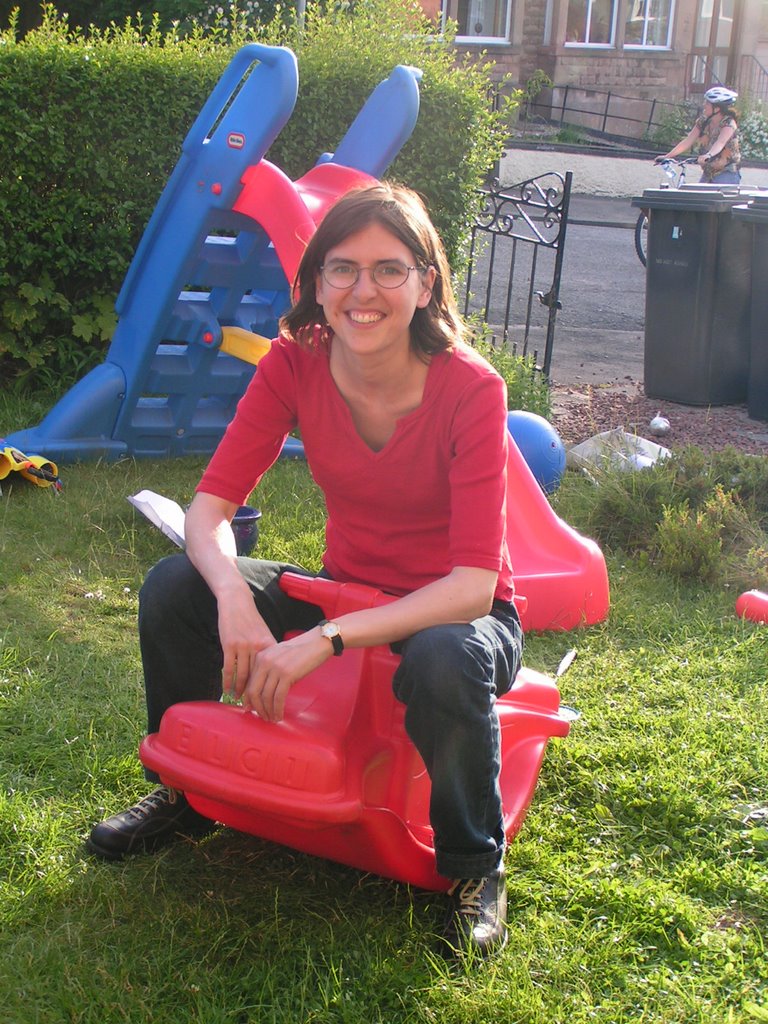


Then a couple of weeks later we got a call saying she was back because her flat sale had fallen through. She finally leaves today, and went out for dinner with Cath and another friend. Gunnar, who was back over to help, was at a loose end, so he came over and we drank wine and shot the shit ('Wir haben das scheise geschossen'?), mainly about Hizbollah. Some significican t points:

  • Israel are in real trouble if even reasonable people like us are coming down in favour of Hizbollah.
  • On the other hand...the Israelis have managed to do something that noone's managed in the last 40-odd years: to unite all the Lebanese factions.
  • Why did Israel start the Gaza blockade? Sure, they'd had a soldier kidnapped, but Palestinians are getting captured (and rourinely shelled) every other day. Is it possibly coincidential that on the day of the invasion, Hamas had just signed an accord with the PLO that even the militant PLO factions wouldn't agree to?
  • The report into the Hariri asaination seems to have disappeared. But then evidence had been uncovered of BND (German intelligence) involvement in Lebanon...and the explosive used was the same type that Mosad used.
  • Hezbollah isn't actually a proscribed organisation in the UK. It's External Operations wing is - and that's the part financed/operated by Iran. This grew out of an Iraqi shiite organisation called Dawa and was responsible for the suicide bombing of the US embassy. The leader of Dawa was one Nuri al-Maliki

Anyway...that was the shit shot.